
6 Things Most People Miss When Buying Waterfront Property
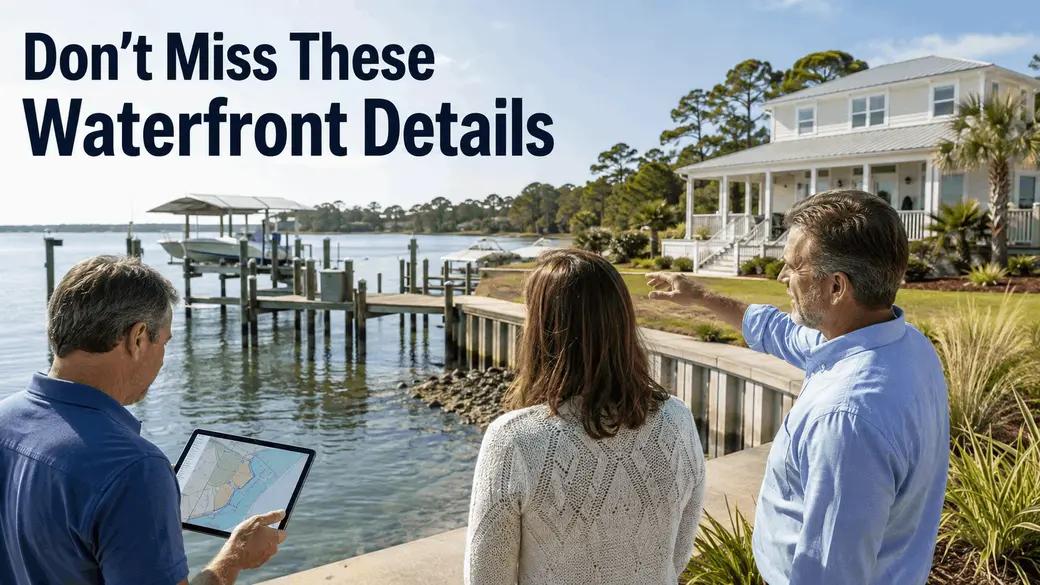
Buying waterfront property on Florida’s Emerald Coast can give you something most homes simply cannot: direct access to the water.
But buyers sometimes spend so much time looking at the view that they forget to investigate what actually comes with it.
A waterfront purchase can involve docks, boat lifts, seawalls, flood exposure, water depth, permits, insurance, access rights, and maintenance expenses that do not normally appear in an inland home purchase.
Before buying waterfront property in Destin, Fort Walton Beach, Niceville, Navarre, Gulf Breeze, Pensacola, 30A, or elsewhere in Northwest Florida, pay attention to these six often-overlooked details.
Waterfront Buyer Quick Check
| What Buyers Sometimes Miss | Why It Matters |
|---|---|
| Whether the water is actually usable | Waterfront does not automatically mean usable boating access |
| Property and water-access rights | A view does not necessarily give you every right you expect |
| Dock, lift, and seawall condition | Marine structures can create major repair expenses |
| Flood insurance details | The house and waterfront structures may have different coverage |
| Permit history | Existing structures do not automatically mean approved structures |
| Long-term ownership costs | Salt, water, storms, and marine equipment can increase maintenance |
1. Waterfront Does Not Automatically Mean Usable Water Access
A listing may say “waterfront,” but that does not tell you whether the property works for the way you want to use the water.
A buyer who wants sunsets may be completely happy with shallow bayfront water.
A buyer who owns a large boat may not be.
Before purchasing, investigate:
-
Water depth
-
Water depth at lower tides
-
Boat draft requirements
-
Bridge clearance
-
Canal width
-
Navigation routes
-
Wake exposure
-
Current
-
Shoreline conditions
-
Whether dredging is allowed or practical
-
Whether the dock reaches usable water
-
Whether the water is appropriate for swimming or paddling
A beautiful dock can be mostly decorative if your boat cannot reach it.
The same applies to access.
A waterfront property may have a view of navigable water without providing the exact boating, swimming, or shoreline use you imagined.
Visit the property from the water when practical.
If boating is one of the primary reasons you are buying, do not stop the investigation at the backyard.
2. Buyers Sometimes Forget to Verify Their Actual Waterfront Rights
Owning land beside the water can involve property rights that are more complicated than a normal fenced residential lot.
Questions can arise involving:
-
Property boundaries
-
Easements
-
Shared docks
-
Community boat access
-
Submerged lands
-
Shoreline boundaries
-
Dock placement
-
Neighboring waterfront rights
-
Access across another property
Florida waterfront law can involve riparian or littoral rights, navigability, sovereign submerged lands, and the location of the high-water boundary. These questions can become legally complicated and may depend on the particular waterbody and property.
That is why a waterfront buyer should not assume:
“The dock is behind the house, so everything behind the house belongs to me.”
Before Closing, Consider Reviewing
-
Current boundary survey
-
Recorded easements
-
Title documents
-
Dock agreements
-
Shared-access agreements
-
HOA documents
-
Submerged-land documents when applicable
-
Available permits
For complicated boundary or water-right questions, a Florida real estate attorney and qualified surveyor may be appropriate.
Your real estate agent can help identify the questions.
The legal professionals should answer the legal ones.
3. The Dock and Seawall May Be More Important Than the Kitchen
Buyers often spend a lot of time evaluating countertops and flooring while giving the dock or seawall a five-minute look.
That can be backwards.
Waterfront structures may include:
-
Dock decking
-
Pilings
-
Boat lift
-
Lift cables
-
Motors
-
Electrical service
-
Seawall
-
Bulkhead
-
Riprap
-
Retaining structures
-
Boat ramp
-
Shoreline stabilization
Florida DEP regulates many waterfront activities involving docks, piers, dredging, boat ramps, wetlands, surface waters, and shoreline stabilization. Northwest Florida falls within DEP’s Northwest District for many of these permitting matters.
A normal home inspection may not provide a complete evaluation of these structures.
Depending on the property, consider asking an appropriate marine contractor, structural professional, electrician, or other specialist to evaluate:
-
Pilings
-
Seawall movement
-
Cracking
-
Tiebacks
-
Dock framing
-
Marine-grade electrical systems
-
Boat-lift capacity
-
Corrosion
-
Remaining useful life
-
Expected repair costs
Ask a Particularly Important Question
How much would this waterfront infrastructure cost me if I had to repair or replace it?
That number belongs in your buying decision just as much as the roof or HVAC system.
4. Flood Insurance May Not Cover Everything You Think It Does
Most homeowners insurance does not cover flooding.
Florida law now requires residential sellers to provide buyers with a statutory flood disclosure at or before execution of the sales contract. The disclosure addresses known flood damage during the seller’s ownership, flood-related insurance claims, and certain flood assistance.
Buyers should still perform their own investigation.
Review:
-
FEMA flood zone
-
Elevation certificate, when available
-
Building elevation
-
Flood history
-
Seller disclosure
-
Drainage
-
Storm-surge exposure
-
Homeowners insurance quote
-
Flood insurance quote
-
Hurricane deductible
-
Coverage exclusions
FEMA notes that every property has some level of flood risk, and coastal V and VE zones include additional risk from storm waves.
Here Is the Detail Many Waterfront Buyers Miss
Flood coverage for the house does not necessarily mean your expensive waterfront structures are covered.
Florida’s Department of Financial Services notes that standard National Flood Insurance Program coverage excludes items such as piers, seawalls, bulkheads, wharves, docks, boathouses over water, and outdoor swimming pools.
That means a buyer could own:
-
A home
-
A $40,000 boat lift
-
A substantial dock
-
A long seawall
…and discover that the flood policy treats those items very differently.
Ask the insurance professional specifically:
“What happens to my dock, lift, seawall, pool, and detached structures if they are damaged?”
Do not assume.
Get the answer in writing from the appropriate insurance professional.
5. An Existing Dock Does Not Automatically Mean You Can Modify It
Seeing a dock behind the house may make a buyer think:
“Great. I can just make it larger later.”
Maybe.
Maybe not.
Florida’s Environmental Resource Permitting system covers many activities involving surface waters, docks, dredging, and submerged lands. Some qualifying single-family dock projects can be exempt or use a self-certification process, while others require additional permitting or authorization.
DEP specifically identifies activities such as docks, piers, boat ramps, dredging, and shoreline stabilization within waterfront permitting programs.
Depending on the property, approvals may involve:
-
Florida DEP
-
Local government
-
Water management authorities
-
Federal agencies
-
HOA or community restrictions
-
Submerged-land authorization
Before Buying, Ask
-
Was the existing dock permitted?
-
Was the boat lift permitted?
-
Were repairs or additions permitted?
-
Does the permit match what exists?
-
Can the dock legally be expanded?
-
Can another lift be added?
-
Can the channel be dredged?
-
Can the seawall be replaced?
-
Are there environmental restrictions?
-
Do HOA rules create additional limitations?
Do not buy based on a future waterfront improvement until you have verified that the improvement is actually possible.
6. The True Cost of Waterfront Ownership Is Easy to Underestimate
Waterfront homes may require all the normal expenses of owning a house plus additional maintenance associated with water, humidity, storms, salt exposure, and marine structures.
Depending on the property, that may include:
-
Dock repairs
-
Boat-lift service
-
Pilings
-
Seawall maintenance
-
Shoreline stabilization
-
Marine electrical work
-
Exterior hardware replacement
-
Pressure washing
-
Protective coatings
-
Storm preparation
-
Flood insurance
-
Wind insurance
-
Higher deductibles
-
Post-storm inspections
-
Drainage maintenance
-
Landscaping exposed to salt or wind
Emerald Group’s existing waterfront guidance also encourages buyers to investigate flood zones, elevation, docks, insurance, permits, and long-term maintenance rather than focusing only on the view.
Build a Waterfront Reserve
When comparing properties, estimate more than the mortgage payment.
Consider creating a worksheet like this:
| Ownership Expense | What to Investigate |
|---|---|
| Homeowners insurance | Premium, wind coverage, deductibles |
| Flood insurance | Premium, elevation, coverage limits |
| Dock | Current condition and expected repairs |
| Boat lift | Capacity, age, motor, cables, electrical |
| Seawall | Condition and estimated remaining life |
| Exterior | Corrosion, paint, hardware, windows |
| Storm preparation | Shutters, cleanup, inspections |
| Property reserves | Cash available for major waterfront repairs |
A waterfront property may still be worth every penny.
The point is to know which pennies you will probably need.
Bonus: Think About the Next Buyer Too
The features that make a waterfront property valuable to you may also influence its future resale.
Future buyers may care about:
-
Water depth
-
Boat access
-
Bridge clearance
-
Dock condition
-
Seawall condition
-
Flood history
-
Insurance cost
-
Elevation
-
View
-
Privacy
-
Water quality
-
Wake exposure
-
HOA restrictions
-
Short-term rental rules
Two waterfront homes with similar square footage can have completely different ownership experiences.
One may provide direct deep-water boating access.
Another may provide a beautiful sunset but shallow water.
Neither is necessarily better.
They serve different buyers.
Questions to Ask Before Making an Offer
Before buying waterfront property, ask:
-
What type of water is behind the property?
-
What is the water depth at lower tide?
-
Can my boat reach open water?
-
Are there bridges or other navigation restrictions?
-
What waterfront rights transfer with the property?
-
Are there easements or shared access?
-
Was the dock permitted?
-
Was the boat lift permitted?
-
What condition is the seawall in?
-
Can the dock or lift legally be modified?
-
What flood zone is the home in?
-
Is an elevation certificate available?
-
What does the flood policy exclude?
-
What does the homeowners policy exclude?
-
How much should I reserve annually for waterfront maintenance?
FAQs About Buying Waterfront Property
Is every waterfront home good for boating?
No. Water depth, tides, bridge clearance, navigation routes, dock configuration, and boat size can determine whether the property works for a particular boat.
Does flood insurance cover a dock or seawall?
Standard NFIP flood coverage excludes several waterfront structures, including piers, seawalls, bulkheads, wharves, docks, and certain boathouses. Buyers should discuss available coverage with an insurance professional.
Does an existing dock mean it was properly permitted?
Not necessarily. Buyers should request available permit records and verify the property with the relevant permitting authorities when appropriate.
Can I add a boat lift after buying?
Possibly. The answer depends on the dock, waterbody, environmental rules, property rights, local requirements, and applicable permits or exemptions. Florida DEP provides permitting and self-certification options for certain qualifying single-family dock projects.
Should I get a separate seawall inspection?
When a seawall represents a significant part of the property’s value or potential future expense, obtaining an evaluation from an appropriately qualified professional may provide useful information beyond a standard home inspection.
Is waterfront property always a better investment?
No. Waterfront value depends on the purchase price, location, access, condition, insurance, maintenance, market demand, and future resale. A property should be evaluated individually.
Final Thoughts
Most waterfront buyers remember to look at the view.
The smartest buyers also investigate what is underneath it, attached to it, insured around it, and legally allowed beside it.
The six often-overlooked waterfront issues are:
-
Whether the water is actually usable
-
What waterfront rights come with the property
-
The condition of the dock, lift, and seawall
-
What flood and homeowners insurance actually cover
-
Whether waterfront improvements are permitted
-
The real long-term maintenance cost
Emerald Group, Brokered by LPT Realty helps buyers evaluate waterfront properties throughout Destin, Fort Walton Beach, Niceville, Navarre, Gulf Breeze, Santa Rosa Beach, 30A, Pensacola, and the surrounding Emerald Coast.
For more waterfront guidance, read What Should I Know Before Buying Waterfront Property? or compare cash vs. VA financing on waterfront property.
You can also compare a condo vs. single-family home near the water.
Ready to evaluate actual waterfront properties? Browse current Emerald Coast homes for sale or contact Emerald Group for local buyer guidance.
Categories
- All Blogs (205)
- 30A Communities & Condos (12)
- Communities and Condos on the Emerald Coast (39)
- Destin Communities & Condos (8)
- Fort Walton Beach Communities & Condos (12)
- Home Buying Tips (20)
- Home Selling TIps (11)
- Investment & Rental Strategy (13)
- Local Real Estate Answers (66)
- Military Relocation & VA Buyers (18)
- Navarre Communities & Condos (11)
- Niceville Communities & Condos (4)
- Panama City Beach Communities & Condos (1)
- Pensacola Communities & Condos (1)
- Waterfront & Coastal Homes (7)
Recent Posts







"My job is to find and attract mastery-based agents to the office, protect the culture, and make sure everyone is happy! "