
Navarre Waterfront vs. Inland Homes: Which Ownership Style Fits You?
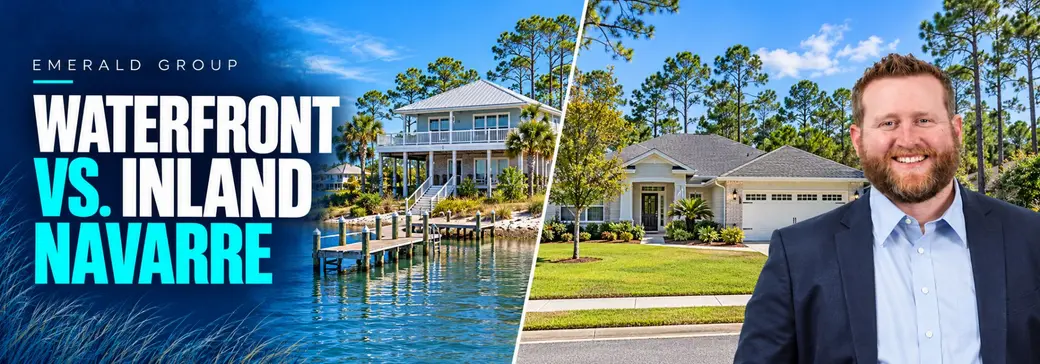
Navarre Waterfront vs. Inland Homes: Which Ownership Style Fits You?
Last verified: October 28, 2026
Buying in Navarre often comes down to a simple-looking question:
Do you want the water in your backyard, or would you rather live inland and keep the water nearby?
The answer affects much more than your view.
A waterfront home may give you private boating access, fishing, paddling, sunsets and a lifestyle that is difficult to recreate inland. But waterfront ownership can also introduce docks, seawalls, flood exposure, marine maintenance, permitting questions and higher carrying costs.
An inland Navarre home may offer more house, yard, garage space or newer construction for the same budget while still keeping Santa Rosa Sound and Navarre Beach within driving distance.
Neither option is automatically better.
The useful question is:
Will you use the waterfront enough to justify everything that comes with owning it?
Before comparing individual properties, buyers can start with Emerald Group's current Navarre Neighborhood Guide to see the broader mix of homes available across Navarre.
Navarre Waterfront vs. Inland at a Glance
| Buyer Priority | Waterfront Home | Inland Home |
|---|---|---|
| Water view | Major advantage | Usually limited |
| Private boating access | Possible depending on property | Usually requires trailering or community/public access |
| Purchase price | May include a waterfront premium | Often broader price selection |
| House/yard for the money | Often less | Often more |
| Flood research | Critical | Still required |
| Dock/seawall | May be owner responsibility | Usually none |
| Marine corrosion | Greater concern | Generally less exposure |
| Insurance | Property-specific; waterfront factors matter | Property-specific |
| Storm preparation | May involve marine structures | Usually simpler |
| Garage/storage | Property-specific | Often more choices |
| Neighborhood selection | More limited | Broader |
| Best fit | Buyers who will actively use the water | Buyers prioritizing space, budget and simpler ownership |
1. First Decide What “Waterfront” Means in Navarre
This is where buyers can get tripped up.
A Navarre search can include several very different water settings.
Depending on the exact property, “waterfront” might mean:
-
Santa Rosa Sound frontage
-
East Bay or East Bay River frontage
-
Canal frontage
-
Navarre Beach Sound-side property
-
Navarre Beach Gulf-front property
-
A property with a dock
-
A property with a water view but no private access
-
A community with shared waterfront or boat access
Those are not interchangeable.
For example, Emerald Group's live Navarre inventory currently includes an East Bay River property advertised with roughly 388 feet of river frontage. That ownership experience is very different from a home directly on Santa Rosa Sound or a Gulf-front property on Navarre Beach.
So before asking:
“Is it waterfront?”
ask:
“What water is it on, and what can I actually do with that water?”
2. Waterfront Does Not Automatically Mean Boat-Ready
A dock in the listing photos does not automatically mean your boat will work there.
Before buying, investigate:
-
Water depth
-
Typical depth at low water
-
Navigation route
-
Bridge clearance
-
Dock dimensions
-
Boat-lift capacity
-
Channel conditions
-
Shoreline configuration
-
Riparian rights
-
Recorded easements
-
Whether the dock is properly permitted
If boating is the main reason you want waterfront, take your actual boat specifications with you.
A gorgeous waterfront property is considerably less useful when your boat cannot reach open water.
For a deeper due-diligence list, Emerald Group's 6 Things Most People Miss When Buying Waterfront Property is a useful companion guide.
3. Docks and Seawalls Add Another Layer of Ownership
Waterfront buyers are not only buying the house.
They may also be buying:
-
Dock
-
Pilings
-
Boat lift
-
Electrical service at the dock
-
Seawall or bulkhead
-
Shoreline stabilization
-
Steps or boardwalks
-
Marine hardware
Santa Rosa County currently requires zoning approval and building permits before construction of certain coastal structures including docks, piers, boathouses, seawalls and retaining walls.
The county also publishes rules addressing dock dimensions, riparian setbacks and public access along waterways including Santa Rosa Sound and East Bay.
That means a waterfront buyer should ask:
Was everything already on the property properly permitted?
And if your plan is:
“I'll just add a bigger dock after closing,”
verify that plan before buying.
The waterfront equivalent of “I'll knock down this wall later” can involve considerably more government paperwork.
4. Flood Zone and Evacuation Zone Are Not the Same Thing
Santa Rosa County specifically warns residents that flood zones and evacuation zones measure different risks.
Flood zones are FEMA-designated areas used for flood-risk and National Flood Insurance Program purposes.
Evacuation zones are based primarily on storm-surge conditions and emergency planning.
A property can be in one type of zone and not the other.
That matters for both waterfront and inland homes.
Do not assume:
Waterfront = flood zone
and
Inland = no flood risk.
Instead check the exact parcel.
For every property, investigate:
-
FEMA flood designation
-
Evacuation zone
-
Elevation information
-
Flood history when available
-
Drainage
-
Flood-insurance quote
-
Homeowners-insurance quote
An inland home near a drainage feature, creek or low-lying area can still deserve serious flood research.
5. Waterfront Insurance Should Be Researched Before You Fall in Love With the View
Insurance can turn two similarly priced homes into two very different financial decisions.
For a waterfront property, investigate:
-
Roof age
-
Roof type
-
Wind mitigation
-
Elevation
-
Flood zone
-
Construction type
-
Foundation
-
Storm protection
-
Replacement cost
-
Flood coverage
-
Deductibles
Also inspect docks, lifts and shoreline structures separately from the house itself.
Do not estimate insurance based on what the seller or neighbor currently pays.
Get a quote for your purchase of that specific property.
The same principle applies inland.
A newer inland home with a newer roof may create one insurance profile. An older inland home with aging systems may create another.
Waterfront vs. inland is only one variable.
6. Waterfront Maintenance Is Different, Not Just “More”
Every house needs maintenance.
Waterfront ownership simply adds different systems.
Potential waterfront work can include:
-
Dock-board replacement
-
Pilings
-
Lift motors and cables
-
Seawall repairs
-
Shoreline erosion
-
Marine electrical equipment
-
Corrosion
-
Salt exposure
-
Storm debris
-
Exterior fasteners
-
Outdoor plumbing
-
Boat equipment
An inland home may avoid nearly all of those items but still have:
-
Large yard
-
Mature trees
-
Pool
-
Older roof
-
Septic system
-
HVAC replacement
-
Fence maintenance
So do not ask:
“Which one has less maintenance?”
Ask:
“Which maintenance do I want to own?”
7. Inland Navarre Can Still Give You a Boating Lifestyle
This is one of the strongest arguments for comparing inland homes.
You do not necessarily need waterfront property to use the water regularly.
Santa Rosa County currently operates public boating facilities in the Navarre area, including the Navarre Beach Boat Ramp, which has parking and a floating dock.
The county also maintains the Holley Boat Ramp in Navarre.
That creates another ownership model:
Buy more house or land inland → store the boat at home → trailer it to the water.
For some buyers, that is considerably cheaper and simpler than maintaining private waterfront infrastructure.
For others, loading the trailer every Saturday morning defeats the entire reason they moved to Navarre.
That's a lifestyle question, not an investment slogan.
8. Inland Can Give Buyers More Property Choices
Emerald Group's current Navarre guide describes the area as a mix of waterfront homes, new construction and established residential neighborhoods.
Once buyers move away from direct waterfront, the search may open to more:
-
New construction
-
Established subdivisions
-
Larger lots
-
Garages
-
Workshops
-
Boat/RV parking
-
Cul-de-sacs
-
HOA and non-HOA options
For example, Holley by the Sea provides a very different ownership style from direct waterfront.
It is a large mainland community with private recreational amenities and access to coastal recreation without requiring every homeowner to personally maintain a shoreline.
Emerald Group's Living in Holley by the Sea guide provides a deeper look at that option.
9. Highway 98 Location Still Matters
Waterfront can be beautiful.
It can also put you somewhere that is less convenient for the rest of your week.
Buyers commuting toward Hurlburt Field, Pensacola or other employment centers should test the exact route from the property.
This is especially important because Navarre homes north and south of Highway 98 can create different commute patterns and coastal-access tradeoffs.
Emerald Group's existing North vs. South of Highway 98 in Navarre guide goes deeper into that location decision.
A waterfront sunset is fantastic.
It does not shorten Monday morning traffic.
10. Navarre Beach Is Its Own Special Case
Buyers should also distinguish Navarre Beach from mainland Navarre.
Navarre Beach is located on Santa Rosa Island and operates under its own planning overlay and existing lease structure.
Santa Rosa County's current comprehensive planning documents state that Navarre Beach is subject to parcel-specific and island-wide lease agreements.
So if your idea of “Navarre waterfront” means:
a Gulf-front or Sound-side home on Navarre Beach,
your due diligence should go beyond the waterfront questions in this guide.
Also verify:
-
Lease documents
-
Lease fee
-
Remaining lease terms
-
Navarre Beach zoning
-
Flood and coastal construction requirements
-
Barrier-island storm exposure
-
Insurance
-
Rental rules if relevant
That is a different ownership structure from most mainland Navarre homes.
11. Do Not Pay for Waterfront You Will Not Use
This is probably the most important decision test.
Imagine two homes at the top of your budget.
Home A
Smaller house, direct water frontage, dock and spectacular sunset view.
Home B
Larger inland home, bigger garage, newer systems and room for the boat trailer.
Ask yourself:
How many days per month will I actually use the waterfront?
If the answer is:
“Almost every day.”
Home A may provide value that Home B can never reproduce.
If the answer is:
“We like looking at water, but we boat four times a year.”
you may be paying a lot for a feature that mostly appears behind your patio furniture.
Waterfront May Fit You Better If You:
-
Boat frequently
-
Want the boat at your property
-
Fish regularly
-
Kayak or paddle often
-
Strongly value a water view
-
Spend significant time outdoors
-
Understand dock/seawall ownership
-
Have room for specialized maintenance
-
Are comfortable researching flood and insurance carefully
Inland May Fit You Better If You:
-
Want more home for the budget
-
Prefer a larger yard
-
Need garage or storage space
-
Want newer-construction choices
-
Prefer fewer marine structures
-
Would rather trailer your boat
-
Prioritize commute
-
Want broader neighborhood options
-
Like living near the coast without maintaining the shoreline
The Navarre Waterfront Stress Test
Before making an offer on a waterfront home, compare:
| Question | Waterfront Property |
|---|---|
| What body of water is it on? | |
| Do I legally have water access? | |
| What is the usable water depth? | |
| Can my boat navigate the route? | |
| Is there a dock? | |
| Was the dock permitted? | |
| What condition is the lift in? | |
| Is there a seawall? | |
| What condition is it in? | |
| What is the flood designation? | |
| What is the evacuation zone? | |
| What are insurance quotes? | |
| What annual marine maintenance should I budget? | |
| How often will I actually use the water? |
Then compare the waterfront property against an inland home at the same total ownership budget.
That last part matters.
Do not compare a $700,000 waterfront mortgage with a $700,000 inland mortgage.
Compare:
purchase price + insurance + flood coverage + HOA + dock/lift/seawall costs + normal home maintenance.
Navarre Waterfront Buyer Checklist
Before buying waterfront, verify:
-
Exact waterfront type
-
Legal access rights
-
Survey and property boundaries
-
Water depth
-
Navigation route
-
Bridge clearance if relevant
-
Dock permits
-
Dock condition
-
Boat-lift capacity
-
Seawall or shoreline condition
-
Flood zone
-
Evacuation zone
-
Elevation information
-
Homeowners insurance
-
Flood insurance
-
HOA restrictions
-
Expected maintenance
-
Actual commute
Navarre Inland Buyer Checklist
Before buying inland, verify:
-
Parcel-specific flood information
-
Drainage
-
Roof age
-
Homeowners insurance
-
Septic or sewer
-
HOA or non-HOA structure
-
Yard maintenance
-
Garage/storage
-
Boat or RV parking if relevant
-
Distance to boat ramps
-
Distance to Navarre Beach
-
Actual commute
-
Major-system age
-
Total annual ownership cost
The Bottom Line
Waterfront may be worth the premium when the water is something you will actively use.
Inland may be the better ownership style when your priorities are space, flexibility, garage/storage, newer construction, commute or simpler maintenance.
Navarre makes the comparison interesting because you can live inland and still keep Santa Rosa Sound, public boat launches and Navarre Beach relatively close.
So do not ask:
“Is waterfront better?”
Ask:
“Will this specific waterfront improve my life enough to justify what I am giving up to own it?”
That's the question that usually leads to the better purchase.
Emerald Group, Brokered by LPT Realty helps buyers compare waterfront and inland Navarre properties by flood exposure, boating access, dock and shoreline considerations, insurance, commute and total ownership costs rather than simply comparing the view.
Sources & Verification
Santa Rosa County — Coastal Construction: Current county requirements and permitting considerations for docks, piers, seawalls and other waterfront structures.
Santa Rosa County — Flood Zones vs. Evacuation Zones: Current explanation of the two different risk designations buyers should verify.
Santa Rosa County — Navarre Beach Planning: Current planning documents covering Navarre Beach's lease and coastal land-use structure.
Santa Rosa County — Navarre Beach Boat Ramp / Holley Boat Ramp: Current public boating-access information.
U.S. Census Bureau TIGERweb: Current geographic reference information for Navarre CDP.
Categories
- All Blogs (246)
- 30A Communities & Condos (12)
- Communities and Condos on the Emerald Coast (51)
- Destin Communities & Condos (8)
- Fort Walton Beach Communities & Condos (17)
- Home Buying Tips (26)
- Home Selling TIps (12)
- Investment & Rental Strategy (18)
- Local Real Estate Answers (68)
- Military Relocation & VA Buyers (21)
- Navarre Communities & Condos (16)
- Niceville Communities & Condos (6)
- Panama City Beach Communities & Condos (1)
- Pensacola Communities & Condos (3)
- Waterfront & Coastal Homes (8)
Recent Posts


"My job is to find and attract mastery-based agents to the office, protect the culture, and make sure everyone is happy! "