
Buying a Home With Boat or RV Parking in Navarre: What to Verify First
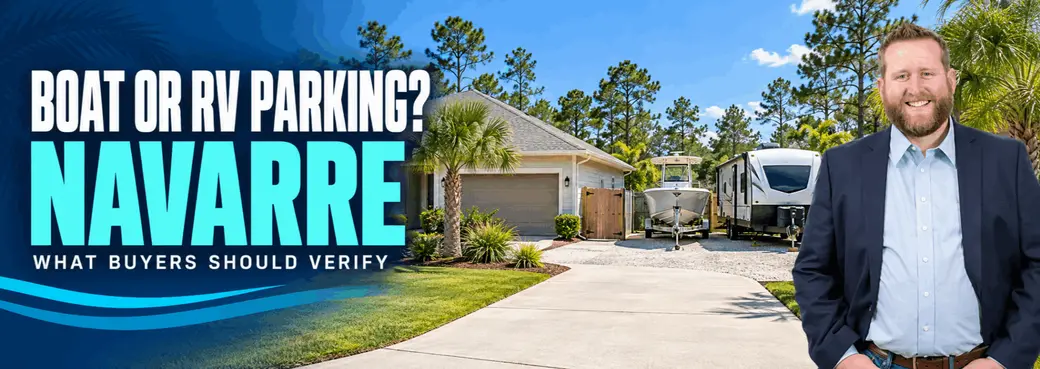
Buying a Home With Boat or RV Parking in Navarre: What to Verify First
Last verified: October 27, 2026
If boat or RV parking is a must-have when buying a home in Navarre, do not stop at:
“The yard looks big enough.”
You need to verify three separate things:
Is it allowed?
Does it physically fit?
Can you actually use the space without creating another problem?
Those answers can depend on Santa Rosa County rules, HOA covenants, recorded restrictions, setbacks, easements, drainage, septic location, driveway access and the actual dimensions of your boat or RV.
The best time to figure this out is before you buy the house, not after a 34-foot travel trailer is sitting in the street wondering where its new bedroom went.
Boat and RV Parking: The Quick Check
| Verify | Why It Matters |
|---|---|
| HOA rules | An association may regulate or prohibit certain parking/storage |
| Recorded restrictions | A non-HOA property can still have deed restrictions |
| County zoning/code | Private rules are not the only rules |
| Actual RV/boat dimensions | “Plenty of room” can disappear once you include the trailer tongue |
| Gate and driveway width | Getting into the space matters as much as the space itself |
| Easements and setbacks | Usable-looking side yards may not be fully buildable |
| Drainage | A new pad cannot simply create a stormwater problem |
| Septic/utilities | Tanks, drainfields and utility lines can limit parking-pad locations |
| Surface | A heavy RV on soft soil is a different situation from a proper pad |
| Power/water plans | Storage and occupancy are different uses |
| Boat-ramp access | Home storage is only half the boating equation |
1. Read the HOA Rules Before You Fall in Love With the Parking Pad
This should come first.
Navarre includes both HOA and non-HOA properties, and the rules can vary dramatically from one community to another.
An HOA may regulate:
-
Boats
-
RVs
-
Travel trailers
-
Utility trailers
-
Driveway parking
-
Side-yard parking
-
Street parking
-
Fences
-
Gates
-
Storage structures
-
Parking pads
So if the listing says:
“RV parking!”
your next question should be:
“According to whom?”
A listing description is marketing.
The governing documents are the answer.
Holley by the Sea Is a Good Example
Holley by the Sea currently identifies itself as a mandatory association with more than 4,700 lots and directs buyers and owners to its governing documents and Architectural Department. Its public document portal includes association rules and policies dated March 1, 2026.
That means a buyer considering boat or RV parking there should review the current documents for the specific property, rather than relying on an old screenshot, a neighbor's setup or what was allowed years ago.
Also check the estoppel for existing violations.
A large lot does not automatically equal unrestricted storage.
2. Know What Santa Rosa County Currently Says About RV Storage
This is an important distinction.
Santa Rosa County's current Land Development Code states that unoccupied recreational vehicles may be stored in residential districts on the same lot as the principal residential structure.
The RV must remain fully licensed and ready for highway use. The code describes that as remaining on wheels or a jacking system, using only quick-disconnect utilities and security devices, and having no permanent additions such as rooms, stairs, decks or porches.
That's useful for a buyer who wants to keep an RV at home.
But it does not mean:
“Anything goes as long as it's in my yard.”
HOA restrictions, recorded covenants, easements, setbacks and other property-specific limitations can still matter.
And storing an RV is different from living in it.
Santa Rosa County's code generally prohibits using an RV as permanent living quarters outside specified exceptions and permitted situations.
So if your plan is:
“We'll park the fifth wheel beside the house.”
that's one question.
If your plan is:
“My relatives will live in it six months a year.”
that's a very different question.
3. Verify Recorded Restrictions Even When There Is No HOA
This is a common buyer mistake:
No HOA = no rules.
Not necessarily.
A property may have no active homeowners association and still be affected by recorded:
-
Covenants
-
Restrictions
-
Easements
-
Plats
-
Utility rights
-
Drainage easements
That's why the property documents matter.
If boat or RV storage is important enough that you would reject the house without it, make verification part of your purchase decision.
Do not rely solely on an MLS field that says:
Boat Parking: Yes
or
RV Parking: Yes
Emerald Group's current Navarre inventory provides a good example. One recent listing at 2029 Colby Court identifies Boat, Oversized and RV among its parking features. But the same listing also identifies covenants and an HOA.
Those pieces of information should be reviewed together, not separately.
A listing feature tells you what is being marketed.
It does not replace your review of the governing documents.
4. Measure Your Actual Boat or RV
This sounds painfully obvious.
It gets skipped anyway.
Do not measure only the RV body or boat hull.
For an RV, consider:
-
Overall length
-
Width
-
Mirror width
-
Height
-
Air-conditioning units
-
Slide-outs
-
Awning clearance
-
Turning radius
For a boat, consider:
-
Boat length
-
Trailer length
-
Trailer tongue
-
Motor position
-
Width
-
Tower or T-top height
-
Trailer turning radius
A 24-foot boat is not necessarily a 24-foot parking problem.
The trailer may make the entire setup considerably longer.
Measure the Property Too
Verify:
-
Gate opening
-
Side-yard width
-
Distance between house and property line
-
Fence posts
-
Roof overhang
-
HVAC equipment
-
Utility boxes
-
Trees
-
Mailbox location
-
Driveway width
-
Culvert location
Then think about turning, not simply parking.
A side yard may be 12 feet wide and still be practically unusable if you cannot make the turn into it.
5. Find Out What Is Under the Parking Area
This is where an innocent-looking patch of grass can get expensive.
Before planning a new concrete, gravel or paved storage pad, determine whether the area contains or affects:
-
Septic tank
-
Drainfield
-
Utility lines
-
Drainage easement
-
Swale
-
Culvert
-
Recorded easement
-
Well
-
Stormwater features
Santa Rosa County's Land Development Code specifically addresses zoning, setbacks, access management, stormwater, off-street parking and development standards. Its permitting department also notes that structural work and certain right-of-way or driveway changes may require review or permitting.
So if your plan is:
“I'll just widen the driveway and pour another slab.”
verify that first.
Concrete has an annoying habit of being much easier to pour than to un-pour.
6. Decide Whether You Need Storage or an RV Setup
These are not the same thing.
Some buyers want a place where the RV sits between trips.
Others want:
-
30-amp power
-
50-amp power
-
Water
-
Sewer connection
-
Covered storage
-
Wash-down area
Once you add utilities or structures, the project can become more complicated.
Santa Rosa County's RV storage provision allows highway-ready units with quick-disconnect utility arrangements, but permanent occupancy and permanent attachments are treated differently.
So spell out your intended use before buying:
Storage Only
“I need a legal place to keep my RV.”
Preparation Area
“I want power to run the refrigerator and prepare it before trips.”
Guest Use
“I want people sleeping in it while it is parked here.”
Long-Term Occupancy
“I plan to use it like another dwelling.”
Those are not interchangeable.
Ask the appropriate county and association questions for the actual plan.
7. For Boat Owners, Test the Whole Trip to the Water
Boat parking at home is only half of the equation.
Ask:
How easy is it to get from this driveway to the water?
One public option is the Navarre Beach Boat Ramp at 1453 Navarre Beach Causeway, which Santa Rosa County currently lists with parking and a floating dock.
For any home you're considering, test:
-
Route to your preferred ramp
-
Highway 98 access
-
Tight neighborhood turns
-
Low branches
-
Traffic
-
Trailer-friendly intersections
-
Ramp parking
-
Ramp hours
-
Boat size and draft
-
Where you'll fuel
For someone who boats every weekend, a slightly less impressive house with easy trailer access may be more useful than a prettier house where backing the boat out requires three spotters and a minor act of Congress.
One Navarre Example: Some Communities Handle Storage Differently
Woodlawn Heights illustrates why neighborhood-specific research matters.
The association currently maintains a fenced common boat/RV storage area for owners. Its published information says spaces are limited, access is controlled, registration and insurance information are required, and owners may face a waiting list when spaces are unavailable.
That creates a completely different ownership setup from:
-
Parking your RV in your side yard
-
Keeping a boat behind a fence
-
Renting commercial storage elsewhere
The lesson is not that one system is better.
It's that the community's actual system should be part of your buying decision.
What About a Non-HOA Home?
For buyers specifically seeking flexibility, a non-HOA property can be attractive.
Emerald Group's existing Navarre HOA comparison notes that non-HOA properties may offer more flexibility for boats, RVs and special property plans, but buyers still need to check county zoning, setbacks, easements, drainage, septic or utility locations, recorded restrictions, access and permitting requirements.
That is exactly the right way to think about it.
Non-HOA does not mean no due diligence.
A non-HOA house with a narrow lot, septic drainfield beside the garage and a drainage easement along the rear may be worse for your RV than an HOA property whose rules permit your specific setup.
The Driveway Test
Before making an offer, stand at the property with your measurements.
Ask:
-
Where will the RV or boat actually sit?
-
Can I get it there?
-
Can I get it out?
-
Can I open the RV slides?
-
Can I access storage compartments?
-
Will the trailer clear the gate?
-
Will the boat tower clear branches?
-
Am I blocking the garage?
-
Am I blocking another vehicle?
-
Am I crossing an easement?
-
Is there enough surface to support the weight?
-
Do current rules allow it?
Better yet, if appropriate and permitted by the seller, visualize or test the turning path before closing.
A tape measure can save you from owning the world's most expensive place to park a kayak.
Boat/RV Buyer Verification Checklist
Before purchasing a Navarre home specifically for recreational-vehicle storage, verify:
Rules
-
HOA or association
-
Current governing documents
-
Parking policies
-
Architectural approval requirements
-
Recorded restrictions
-
Existing violations
County
-
Zoning
-
RV-storage rules
-
Setbacks
-
Easements
-
Floodplain considerations
-
Driveway or right-of-way permits if modifications are planned
Property
-
Lot dimensions
-
Gate width
-
Side-yard width
-
Driveway width
-
Turning radius
-
Septic location
-
Drainfield location
-
Utilities
-
Drainage
-
Surface condition
Equipment
-
Total RV dimensions
-
Total boat-and-trailer dimensions
-
Height
-
Width
-
Tongue length
-
Slide clearance
Lifestyle
-
Boat-ramp route
-
Storage security
-
Storm plan
-
Power needs
-
Water needs
-
Whether commercial storage is a better alternative
The Bottom Line
If you are buying in Navarre specifically because you need boat or RV parking, treat that requirement like you would an extra bedroom.
It is not a bonus feature.
It is part of whether the property works.
The safest order is:
Check the rules → check the documents → measure the equipment → measure the property → verify access → investigate any planned improvements.
Do that before closing and you can choose a house that actually accommodates the equipment you already own.
Skip it, and you may discover that the beautiful “RV-ready” side yard is actually a drainage easement behind an HOA-restricted gate.
Emerald Group, Brokered by LPT Realty can help Navarre buyers compare HOA and non-HOA properties, lot layouts, parking features and property-specific restrictions before deciding which homes deserve a closer look.
Sources & Verification
Santa Rosa County Land Development Code — verifies the current county framework for RV storage, zoning, setbacks, access, parking, drainage and other property-development standards.
Santa Rosa County Permitting & Building Compliance — verifies that structural improvements and certain driveway/right-of-way work may require county review or permitting.
Holley by the Sea Improvement Association — verifies the current community structure, governing-document system and public 2026 rules/policies.
Woodlawn Heights Owners Association — verifies its community boat/RV storage system, controlled access and waiting-list process.
Santa Rosa County Navarre Beach Boat Ramp — verifies location, parking and floating-dock access.
Categories
- All Blogs (244)
- 30A Communities & Condos (12)
- Communities and Condos on the Emerald Coast (50)
- Destin Communities & Condos (8)
- Fort Walton Beach Communities & Condos (17)
- Home Buying Tips (26)
- Home Selling TIps (12)
- Investment & Rental Strategy (18)
- Local Real Estate Answers (68)
- Military Relocation & VA Buyers (21)
- Navarre Communities & Condos (15)
- Niceville Communities & Condos (6)
- Panama City Beach Communities & Condos (1)
- Pensacola Communities & Condos (3)
- Waterfront & Coastal Homes (8)
Recent Posts





"My job is to find and attract mastery-based agents to the office, protect the culture, and make sure everyone is happy! "