
7 Reasons to Consider an HOA Community Near Navarre, Florida
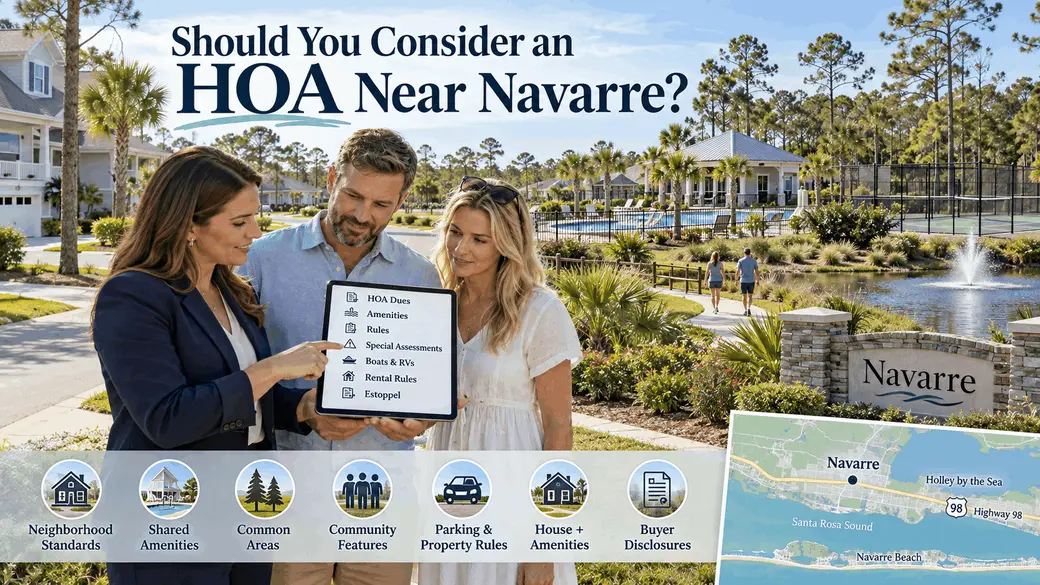
7 Reasons to Consider an HOA Community Near Navarre, Florida
For some homebuyers, the letters HOA immediately mean rules and fees.
For others, they mean amenities, maintained common areas, and clearer expectations about how a neighborhood is managed.
Both reactions can be reasonable.
Navarre offers both HOA and non-HOA properties, so buyers can choose very different ownership experiences. One of the best-known local examples is Holley by the Sea, which currently reports more than 4,700 lots and a 48-acre recreation center.
The useful question is not:
“Are HOAs good or bad?”
It is:
“Does this specific HOA provide benefits I value enough to justify its dues and restrictions?”
Here are seven reasons an HOA community near Navarre may deserve a closer look.
HOA Community vs. Non-HOA Home Near Navarre
| Buyer Priority | HOA Community | Non-HOA Property |
|---|---|---|
| Neighborhood standards | Usually governed by recorded rules | Fewer private community restrictions |
| Amenities | May include pools, fitness, courts or common areas | Usually fewer private shared amenities |
| Dues | Mandatory assessments may apply | No mandatory HOA assessment |
| Exterior changes | May require architectural approval | Generally more owner flexibility, subject to law |
| Boats and RVs | May be regulated | Often more flexible, subject to local rules |
| Rentals | HOA documents may add restrictions | Still subject to law and recorded restrictions |
| Common areas | Association may maintain them | Usually less applicable |
| Buyer due diligence | Governing documents, budget and estoppel matter | Property-level research still matters |
Florida law requires a prospective buyer of property subject to mandatory HOA membership to receive a disclosure summary explaining required membership, restrictive covenants, assessments, possible special assessments, and the importance of reviewing the governing documents.
That makes HOA due diligence part of evaluating the property—not something to deal with after closing.
1. HOA Rules Can Create Clearer Neighborhood Standards
One reason some buyers prefer an HOA is predictability.
Depending on the association, governing documents may address:
-
Exterior maintenance
-
Landscaping
-
Fences
-
Sheds
-
Exterior paint
-
Parking
-
Boats
-
RVs
-
Architectural additions
-
Property upkeep
The exact rules vary from one association to another.
For a buyer who likes the appearance and layout of a particular neighborhood, written standards can provide more information about what owners are expected to maintain.
That does not guarantee every property will always look perfect.
It does mean there is a formal structure governing certain property-use and maintenance issues.
For another buyer, those same rules may feel restrictive.
That is why you should read the actual documents before deciding that an HOA is either a benefit or a drawback.
2. You May Get Amenities You Would Not Want to Maintain Yourself
Shared amenities can be one of the strongest reasons to consider an HOA community.
Depending on the neighborhood, amenities might include:
-
Swimming pool
-
Fitness facilities
-
Tennis or sports courts
-
Clubhouse
-
Community gathering areas
-
Gated entrances
-
Walking areas
-
Waterfront facilities
-
Recreation grounds
Holley by the Sea is an unusually large local example.
Its current facilities include:
-
Lap pool
-
Family pool
-
Baby pool
-
Eight clay tennis courts
-
Weight room
-
Cardio equipment
-
Basketball
-
Volleyball
-
Ball field
-
Beach House event space
-
RV and tent campground
-
Youth programming
The facilities are private. Holley by the Sea states that use is tied to eligible ownership or transferred renter rights rather than general public membership.
That can create a useful ownership tradeoff.
You may not want to personally maintain:
a pool + fitness room + tennis courts + recreation grounds
but you may value having access to them.
Ask Yourself This
Would you actually use the amenities?
A large recreation package may be valuable for one homeowner and nearly irrelevant to another.
Do not pay HOA dues based solely on a long amenity list.
Evaluate the amenities you will realistically use.
3. Common Areas Can Be Maintained Collectively
In many HOA communities, a portion of the assessment supports features owners use collectively.
Depending on the association, that could include:
-
Entrance landscaping
-
Community pools
-
Clubhouses
-
Gates
-
Recreation areas
-
Shared green space
-
Private infrastructure
-
Waterfront facilities
Florida's HOA law defines association assessments and amenity fees as amounts authorized through the governing documents for association operations, common areas, recreational facilities, and related community purposes.
The key phrase is:
depending on the association.
Never assume the HOA maintains something simply because it sits inside the neighborhood.
Instead ask:
“What exactly do my dues pay for?”
Then review:
-
Current budget
-
Reserve information when applicable
-
Governing documents
-
Recent meeting information
-
Special assessments
A low annual fee with few shared responsibilities should be evaluated differently from a community maintaining pools, gates, private roads, or recreation facilities.
The amount alone does not tell you whether the HOA provides value.
4. HOA Communities Can Make Certain Property Searches Easier
Sometimes buyers are not simply searching for:
“a house in Navarre.”
They are searching for a specific ownership experience.
For example:
“I want a community pool.”
“I want organized recreation facilities.”
“I want private community amenities.”
“I want written standards around property use.”
“I want a single-family house but still want shared amenities.”
An HOA can make these features easier to identify because the community structure and amenities are usually documented.
That can be helpful around Navarre because buyers can encounter very different housing types, including:
-
Large planned communities
-
Smaller subdivisions
-
Established mainland neighborhoods
-
New construction
-
Sound-side properties
-
Navarre Beach properties
-
Communities with recreation amenities
The advantage is not simply having an HOA.
The advantage is finding an association whose rules + amenities + costs match what you want from the property.
5. HOA Documents Can Give Clearer Answers About Boats, RVs, Parking and Improvements
This is particularly important around Navarre.
A buyer may own or plan to own:
-
Boat
-
RV
-
Trailer
-
Golf cart
-
Outdoor equipment
They may also want to add:
-
Fence
-
Shed
-
Pool
-
Patio
-
Exterior addition
HOA documents may regulate some or all of those things.
For example, rules could address:
-
Boat parking
-
RV storage
-
Trailer storage
-
Commercial vehicles
-
Street parking
-
Driveway parking
-
Fences
-
Sheds
-
Pools
-
Architectural changes
That can work in either direction.
A buyer who wants to park an RV beside the house may see restrictions as a deal breaker.
Another buyer may specifically prefer a community with rules governing visible recreational vehicles.
Neither preference is inherently better.
The benefit is knowing what the rules are before you purchase the property.
6. You Can Get Community Amenities Without Choosing Condo Ownership
Some buyers like shared amenities but do not want a condominium.
An HOA neighborhood can provide another option:
Own your individual house and lot while sharing certain community facilities.
That may appeal to buyers who want:
-
Detached home
-
Garage
-
Yard
-
Private outdoor space
-
Residential street
while still having access to things such as:
-
Pool
-
Fitness facility
-
Tennis courts
-
Clubhouse
-
Recreation areas
Holley by the Sea is a strong local example of this model because individual residential lots are paired with a large private recreation complex. The association currently reports annual dues and directs owners and buyers to contact its office for the current amount rather than relying on an old published fee.
This can make an HOA community worth comparing not only with other subdivisions, but also with condos or resort-style properties.
The ownership responsibilities are very different.
7. Florida HOA Disclosures Can Give Buyers Important Information Before Closing
The paperwork is not exciting, but this may be one of the most useful reasons to take HOA due diligence seriously.
Florida's mandatory HOA disclosure tells prospective buyers that:
-
Membership is required
-
Restrictive covenants apply
-
Assessments are required
-
Assessments can change
-
Special assessments may apply
-
Unpaid mandatory assessments can result in a lien
-
Buyers should review the actual governing documents
Florida law generally requires that disclosure before the buyer executes the sales contract. If the required disclosure was not provided beforehand, the statute provides a limited cancellation right tied to receipt of the disclosure and closing.
There is also the estoppel certificate.
Under the current 2026 statute, an HOA must generally issue an estoppel certificate within 10 business days after a proper request. The certificate can disclose information such as:
-
Regular assessment amount
-
Whether assessments are paid through a certain date
-
Outstanding assessments
-
Scheduled special assessments
-
Transfer or capital-contribution fees
-
Open violations
-
Transfer-approval requirements
-
Other associations affecting the property
-
Association insurance contact information
That can reveal information you would want to understand before taking ownership.
An attractive home can look different once you discover:
an open violation + upcoming special assessment + transfer fee + rules that conflict with your plans.
What About Rental Restrictions?
If rental flexibility matters, investigate it before purchasing.
Florida law addresses amendments that prohibit or regulate rental agreements. Under the current 2026 statute, post-July 1, 2021 rental restrictions generally apply to owners acquiring title after the amendment or owners who consent, subject to important exceptions. The statute specifically allows certain amendments involving rentals shorter than six months or more than three rentals per calendar year to apply more broadly.
That is one reason not to rely on:
“The neighbor rents theirs, so I can rent mine.”
Review the current governing documents and property-specific situation.
If rental plans materially affect the purchase, appropriate legal advice may also be worthwhile.
The Tradeoff: HOA Benefits Come With HOA Obligations
There is no free community pool.
An HOA owner may take on:
-
Mandatory assessments
-
Possible special assessments
-
Governing restrictions
-
Architectural approval processes
-
Enforcement procedures
-
Amenity rules
-
Parking rules
-
Rental restrictions
-
Boat and RV restrictions
-
Possible transfer or capital-contribution fees
Florida's required HOA disclosure explicitly warns buyers that assessments may change, special assessments may apply, and failure to pay mandatory association assessments can result in a lien.
That is not a reason to avoid an HOA.
It is a reason to understand what you are buying.
HOA Community vs. No HOA: Which Fits Better?
An HOA Community May Fit Your Priorities If You Value:
-
Written neighborhood standards
-
Shared amenities
-
Maintained common areas
-
Pools or fitness facilities
-
Planned community structure
-
Clear rules around property use
A Non-HOA Property May Fit Your Priorities If You Value:
-
Fewer private restrictions
-
More flexibility with exterior projects
-
Potentially easier boat or RV storage
-
No mandatory HOA assessment
-
Greater control over certain property decisions
Do not buy an HOA home just because the pool looks nice.
And do not reject one just because someone online had a bad experience with a completely different association.
Evaluate the actual HOA attached to the actual property.
What Should You Review Before Making an Offer?
Ask these questions:
-
What are the current HOA dues?
-
How frequently are assessments paid?
-
What do the dues cover?
-
Have assessments recently increased?
-
Are special assessments approved or being discussed?
-
Which amenities are included?
-
Who can use those amenities?
-
Are boats, RVs or trailers restricted?
-
What are the parking rules?
-
Do fences, pools, sheds or additions require approval?
-
Are rentals restricted?
-
Is there a minimum rental period?
-
Are there current violations on the property?
-
What does the estoppel certificate show?
-
Are transfer or capital-contribution fees due?
-
What does the association maintain?
-
What does the homeowner maintain?
-
What architectural standards apply?
-
Are major association projects planned?
-
Would you still like the property if dues increased?
Does an HOA Protect Property Values?
Avoid treating that as a guarantee.
An HOA may:
-
Maintain common areas
-
Enforce certain property standards
-
Regulate some uses
-
Operate amenities
But that does not guarantee higher appreciation or resale value.
Future value can depend on:
-
Location
-
Condition
-
Purchase price
-
Insurance
-
Market supply
-
Buyer demand
-
Interest rates
-
HOA finances
-
Dues
-
Restrictions
-
Property features
Some buyers value association rules.
Others actively avoid them.
The more useful question is:
Does this particular HOA create an ownership experience that you—and potentially future buyers—find useful?
What About Holley by the Sea?
Holley by the Sea deserves extra attention because it is not a typical small subdivision HOA.
The association currently reports:
-
More than 4,700 lots
-
A 48-acre recreation center
-
Annual dues
-
Private community amenities
Its facilities currently include multiple pools, tennis courts, fitness equipment, basketball, volleyball, a ball field, event space and camping facilities.
That can be appealing if you will regularly use those facilities.
Someone who wants fewer private restrictions and has little interest in community recreation may reach a different conclusion.
For a deeper look, read Living in Holley by the Sea: What Buyers Should Know.
FAQs
Is an HOA community near Navarre worth considering?
It can be if you value the community's specific amenities, standards or shared facilities enough to justify its dues and restrictions. Evaluate the actual association rather than making a decision based on HOAs in general.
What should I review before buying an HOA home in Florida?
Review the governing documents, current dues, budget information, special assessments, architectural rules, rental restrictions, parking and storage rules, amenity access, and the property's estoppel information. Florida law also requires a disclosure summary for applicable mandatory HOA properties.
Can HOA dues increase?
Yes. Florida's required disclosure specifically warns prospective buyers that association assessments may be subject to periodic change and that special assessments may also apply.
Can an HOA restrict rentals?
Yes, association governing documents may regulate rental activity, subject to Florida law. Current Florida statute includes rules governing when newer rental restrictions apply and special treatment for certain short-term rental restrictions.
Is Holley by the Sea an HOA?
Yes. Holley by the Sea currently reports more than 4,700 lots, annual dues, and a 48-acre private recreation center.
Does an HOA guarantee better resale value?
No. Amenities and neighborhood standards may appeal to some future buyers, while dues or restrictions may make the property less attractive to others. Resale depends on the individual home, association, costs and broader market conditions.
Final Thoughts
Seven reasons a Navarre-area HOA community may be worth considering are:
-
Clearer neighborhood standards
-
Access to shared amenities
-
Collective maintenance of common areas
-
Communities organized around specific ownership preferences
-
Clearer rules for boats, RVs, parking and exterior changes
-
Amenities without necessarily choosing condo ownership
-
Formal documents that can reveal important information before closing
An HOA should not automatically move a property to the top—or bottom—of your list.
The right question is:
Do the amenities, rules and costs fit the way you actually want to own the home?
Emerald Group, Brokered by LPT Realty helps buyers compare HOA and non-HOA properties throughout Navarre and the Emerald Coast based on community rules, amenities, property condition, insurance, commute and total ownership costs.
You can browse current Emerald Coast listings or contact Emerald Group to compare specific Navarre communities.
Categories
- All Blogs (205)
- 30A Communities & Condos (12)
- Communities and Condos on the Emerald Coast (39)
- Destin Communities & Condos (8)
- Fort Walton Beach Communities & Condos (12)
- Home Buying Tips (20)
- Home Selling TIps (11)
- Investment & Rental Strategy (13)
- Local Real Estate Answers (66)
- Military Relocation & VA Buyers (18)
- Navarre Communities & Condos (11)
- Niceville Communities & Condos (4)
- Panama City Beach Communities & Condos (1)
- Pensacola Communities & Condos (1)
- Waterfront & Coastal Homes (7)
Recent Posts







"My job is to find and attract mastery-based agents to the office, protect the culture, and make sure everyone is happy! "