
Can You Short-Term Rent a Home in Santa Rosa Beach?
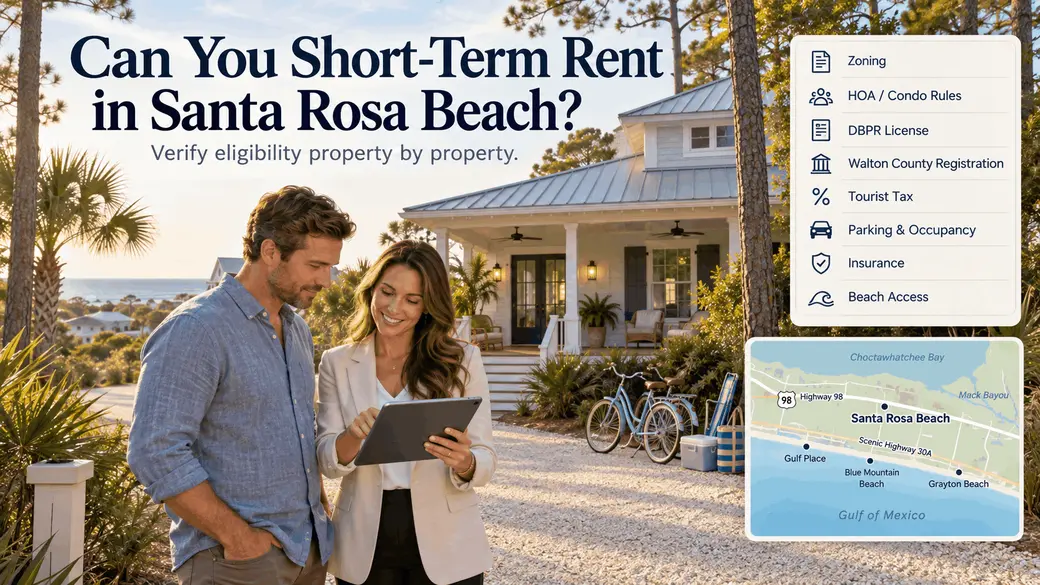
Can You Short-Term Rent a Home in Santa Rosa Beach?
Yes—many homes in Santa Rosa Beach can be used as short-term vacation rentals. But you should never assume a property is rental-friendly simply because nearby homes are listed on Airbnb or Vrbo.
Walton County currently says short-term vacation rentals are permitted in many residential zoning districts in unincorporated Walton County. Properties still have to comply with applicable zoning, parking, occupancy, compatibility, registration, state licensing, tax, and other operating requirements.
Then there is another layer:
An HOA, condo association, or recorded deed restriction may impose its own rental rules.
So the real question for a buyer is not:
“Are short-term rentals allowed in Santa Rosa Beach?”
It is:
“Can this exact property legally and practically operate as the type of short-term rental I want?”
Santa Rosa Beach Short-Term Rentals at a Glance
| Question | Current Answer |
|---|---|
| Are STRs generally possible? | Yes, in many Walton County residential zoning districts |
| Does every property qualify? | No |
| Walton County registration required? | Yes, for applicable STRs |
| Current individual registration fee | $300 per property annually |
| Florida DBPR license? | Generally required for qualifying whole-unit vacation rentals |
| Walton County TDT registration? | Yes, when applicable |
| Current South Walton TDT rate | 5% |
| Can an HOA restrict rentals? | Yes, private restrictions may apply |
| Are Santa Rosa Beach 32459 renewals on the new June 1 cycle? | Not currently; the county lists 32459 as an exception |
| Biggest mistake | Assuming a nearby Airbnb proves your property is eligible |
Walton County's current fee schedule lists $300 per property for individual initial/annual registration and $227 per property for community registration. Operating without required registration can carry a listed fee of $500 per day.
1. Walton County Allows Short-Term Rentals in Many Residential Areas
Walton County's current FAQ says short-term rentals are permitted in many residential zoning districts.
The county does not broadly prohibit vacation rentals in residential-use zones, although properties must satisfy applicable requirements involving:
-
Compatibility
-
Scale
-
Parking
-
Occupancy
-
Design
-
Registration
New construction, conversions, or expansions may also require additional review.
Florida law also limits how local governments may regulate vacation-rental duration and frequency, subject to important exceptions for older local rules.
That provides the broad legal framework.
It does not tell you whether one particular house is ready to operate tomorrow.
How Do You Check a Property's Zoning?
Walton County tells owners and buyers to use its GIS mapping system.
For a property you are considering:
-
Search the address or parcel number.
-
Turn on the Zoning layer.
-
Confirm the zoning district and any overlays.
-
Verify current requirements with Walton County before relying on the property for rental use.
This is particularly important because Santa Rosa Beach covers a broad area—from 30A and Gulf-oriented communities to properties near Highway 98 and Choctawhatchee Bay.
2. You Need More Than County Zoning
A buyer may correctly determine that county zoning permits a vacation rental and still discover another restriction.
Before purchasing, investigate:
HOA Rules
An HOA may regulate:
-
Minimum rental periods
-
Number of rentals per year
-
Guest registration
-
Occupancy
-
Parking
-
Pets
-
Amenity use
-
Golf carts
-
Signs
-
Owner versus guest privileges
Condo Rules
Condominium associations may have additional requirements involving:
-
Rental approval
-
Minimum stays
-
Maximum rental frequency
-
Guest registration
-
Parking
-
Building access
-
Rental management
-
Amenity access
Deed Restrictions
Recorded restrictions can matter even when there is no obvious large HOA.
That is why:
“The county allows STRs”
and
“this property allows STRs”
are two different statements.
3. Florida DBPR Licensing May Be Required
Florida regulates qualifying vacation rentals as public lodging establishments.
The Florida Department of Business and Professional Regulation says that when an entire dwelling is rented more than three times in a calendar year for periods shorter than 30 days or one calendar month—or is regularly advertised for those short stays—it generally falls within the state's vacation-rental licensing framework.
Florida currently licenses vacation rentals primarily as:
-
Vacation Rental – Dwelling
-
Vacation Rental – Condominium
A dwelling classification can include a single-family home, townhouse, duplex, triplex, quadruplex, or similar qualifying dwelling.
DBPR states that owners of new qualifying establishments and new owners of existing vacation-rental establishments must obtain the appropriate license before operating.
What If You Only Rent a Room?
DBPR's current vacation-rental guide distinguishes renting the entire dwelling from renting individual rooms.
Its guidance says renting rooms rather than the entire unit is not classified as a DBPR vacation rental, although other state or local rules may still apply.
If your plan is unusual—such as renting a guest house, part of an owner-occupied property, or multiple units—verify the structure before assuming standard vacation-rental rules apply.
4. Walton County Has Its Own Annual Registration
The state license does not replace Walton County registration.
Walton County's current process requires applicable short-term vacation rentals to register annually.
The county's current checklist identifies prerequisites that may include:
-
Florida Department of State business registration when the property is held by a company
-
Florida Department of Revenue tax registration
-
Florida DBPR licensing
-
Walton County Tourist Development Tax registration
-
Walton County vacation-rental registration
And the county makes an important point:
Having your DBPR, tax, and TDT registrations does not automatically give you Walton County approval.
A complete county application still has to be submitted.
5. Santa Rosa Beach Has a Special 2026 Renewal Detail
Walton County changed the annual renewal schedule for many short-term rentals beginning with the 2026–2027 cycle.
Most applicable properties now move toward a June 1 annual renewal date.
But there is an important exception.
Walton County's current FAQ says properties in ZIP code 32459—the Santa Rosa Beach area—are excluded from that unified June 1 schedule for now and remain on their existing renewal cycle until further notice.
That makes Santa Rosa Beach a good example of why vacation-rental owners should check the county's current guidance instead of relying on an older article or another owner's renewal date.
6. Short-Term Rentals Also Have Tax Obligations
Vacation-rental income comes with tax responsibilities.
Walton County's Clerk currently lists the South Walton Tourist Development Tax rate at 5% for applicable short-term accommodations south of the Intracoastal Waterway, which includes Santa Rosa Beach.
The Tourist Development Tax generally applies to taxable rental revenue and required nonrefundable guest fees.
The Clerk specifically identifies fees such as:
-
Cleaning fees
-
Reservation fees
-
Resort fees
-
Amenity fees
-
Pet fees
when those charges are required and taxable under the applicable rules.
State and local sales taxes can apply in addition to Walton County TDT.
Do Airbnb or Vrbo Handle Everything?
Do not assume the booking platform handles every local tax obligation.
Walton County's current TDT guidance says owners or managers must report all applicable short-term-rental revenue to the county regardless of the platform used and specifically states that rental-ad platforms do not remit Walton County TDT to the Clerk's department on the owner's behalf.
Rental owners should confirm their exact tax setup with the relevant agencies and tax professional.
7. Parking and Occupancy Matter
Rental eligibility is not only about whether short stays are legal.
Walton County says applicable properties must also meet standards involving parking, occupancy, scale, and compatibility.
That becomes particularly important with larger vacation homes.
A house may have:
5 bedrooms + pool + strong beach access
but still create problems if the site does not reasonably support:
-
Guest vehicles
-
Maximum occupancy
-
Trash service
-
Property access
-
Responsible-party requirements
Do not build your rental projections around maximum guest count until you understand what the property can legally accommodate.
8. Beach Access Can Matter as Much as Rental Permission
A property can be completely legal as a vacation rental and still be a weak rental candidate.
One major reason is beach access.
Santa Rosa Beach and South Walton contain different types of:
-
Public beach accesses
-
Neighborhood accesses
-
Private beach areas
-
Association-controlled access
-
Property-specific access rights
A listing that says:
“Near the beach”
does not tell you what a vacation guest can actually use.
Before purchasing, determine:
-
The nearest usable access
-
Walking distance
-
Parking availability
-
Whether beach access is public or private
-
Whether association access transfers to renters
-
Whether guest use differs from owner use
A legally rentable house ten minutes from inconvenient beach access can perform very differently from a property where guests can easily walk to an access point.
9. Insurance Needs to Match the Rental Use
Do not obtain a standard owner-occupied insurance quote and assume it represents your vacation-rental cost.
Tell the insurance professional exactly how you intend to use the property.
Short-term rental use can affect issues such as:
-
Coverage type
-
Liability
-
Premium
-
Deductible
-
Guest-related exposure
-
Property-management requirements
For coastal properties, also investigate flood coverage separately.
Rental revenue should never be analyzed without realistic insurance numbers.
10. Financing Can Change When the Home Is a Vacation Rental
Your intended use matters to the lender too.
There is a meaningful difference between buying a property as:
-
Primary residence
-
Second home
-
Investment property
If you intend to operate the home primarily as a short-term rental, discuss that plan with the lender before making an offer.
Do not describe the property one way for financing and operate it differently immediately afterward without understanding the loan requirements.
Your financing structure can affect:
-
Down payment
-
Interest rate
-
reserves
-
Underwriting
-
Rental-income treatment
11. HOA Rules Can Be More Restrictive Than County Rules
This is one of the biggest Santa Rosa Beach buyer traps.
Imagine that:
-
Walton County zoning works
-
DBPR licensing works
-
County registration works
but the HOA requires a 30-day minimum rental period.
Your weekly vacation-rental strategy may no longer work.
Or an association might allow short stays but impose:
-
Guest-registration fees
-
Parking limits
-
Amenity restrictions
-
Management requirements
-
Rental caps
That means HOA documents should be part of your pre-purchase investment analysis, not something you review after closing.
12. A Current Rental Listing Nearby Is Not Proof
This shortcut causes problems.
Buyers sometimes say:
“The house two doors down is on Airbnb, so this one must be rentable.”
Not necessarily.
The nearby home could have:
-
Different governing documents
-
Grandfathered rights
-
Different zoning
-
Different HOA status
-
Different rental approval
-
Different ownership history
-
Noncompliant operation
Treat nearby rental listings as evidence that vacation rentals exist in the area—not as legal verification for the property you want to buy.
What Should You Verify Before Buying?
A strong Santa Rosa Beach STR due-diligence process should answer these questions:
-
What is the exact zoning?
-
Does Walton County currently allow the intended rental use?
-
Does the HOA or condo association permit it?
-
Are deed restrictions involved?
-
What is the minimum permitted stay?
-
Does Florida DBPR licensing apply?
-
What Walton County registration is required?
-
What is the current registration fee?
-
What Tourist Development Tax registration is needed?
-
How will state and local sales taxes be handled?
-
What occupancy applies?
-
Does parking support that occupancy?
-
Who will be the required responsible party?
-
What insurance quote applies specifically to STR use?
-
What financing classification applies?
-
Where is the actual guest beach access?
-
Can renters use association amenities?
-
What are the current HOA or condo dues?
-
Are special assessments pending?
-
Would the property still make sense if rental revenue is lower than projected?
Can You Airbnb a House in Santa Rosa Beach?
Potentially, yes.
“Airbnb” is simply a booking platform.
The legal question is whether the property itself can be operated as a short-term vacation rental and whether the owner completes the applicable licensing, registration, tax, insurance, and private-association requirements.
Walton County currently permits STRs in many residential zoning districts, but the exact property must still be checked.
What About Mack Bayou and Homes Away From 30A?
Short-term-rental eligibility should not be assumed based on whether the property is on 30A, near Mack Bayou, north of Highway 98, or elsewhere in Santa Rosa Beach.
A property farther from the Gulf may still be legally eligible.
But legal eligibility and rental desirability are separate questions.
For a bay-side or inland property, evaluate:
-
Guest demand
-
Drive to beach access
-
Parking
-
Boat or bay access
-
Bedroom count
-
Pool
-
HOA rules
-
Purchase price
-
Historical performance of genuinely comparable rentals
A lower purchase price does not automatically create a better rental investment.
FAQs
Can you short-term rent a home in Santa Rosa Beach?
Yes, many properties can be operated as short-term vacation rentals. Walton County currently permits STRs in many residential zoning districts, subject to zoning, operating standards, registration, Florida licensing, taxes, and applicable private restrictions.
Does every Santa Rosa Beach property allow Airbnb?
No. HOA rules, condo documents, deed restrictions, zoning, parking, occupancy, and other requirements can make two nearby properties very different.
Do Santa Rosa Beach vacation rentals need a Walton County registration?
Applicable short-term vacation rentals require annual Walton County registration. The current individual initial/annual registration fee is $300 per property.
Do I need a Florida vacation-rental license?
For qualifying whole-unit transient vacation rentals, generally yes. Florida DBPR states that applicable vacation-rental establishments must obtain the appropriate state license before operating.
What is the Walton County tourist tax on Santa Rosa Beach rentals?
The current South Walton Tourist Development Tax rate is 5% on applicable taxable short-term-rental charges, in addition to applicable state and local sales taxes.
Can an HOA stop me from operating a short-term rental?
An HOA or condo association may impose private rental restrictions that apply to the property. County zoning approval does not automatically override those private restrictions.
Is Santa Rosa Beach on Walton County's new June 1 rental-registration renewal schedule?
Not currently. Walton County's 2026 FAQ specifically identifies ZIP code 32459 as an exception to the new unified June 1 schedule. Those properties remain on their existing cycle until further notice.
Can I assume a property is STR-friendly because neighboring homes are vacation rentals?
No. Verify the exact parcel, zoning, governing documents, county registration status, and other requirements independently.
Final Thoughts
So, can you short-term rent a home in Santa Rosa Beach?
Yes—many properties can be used as vacation rentals.
But the correct order is:
Property → zoning → HOA/condo/deed rules → DBPR license → Walton County registration → taxes → insurance → financing → rental economics.
Not:
“It looks good on Airbnb, so buy it.”
The strongest Santa Rosa Beach vacation-rental purchase is a property where all of these work together:
-
Rental use is permitted
-
Private restrictions work with your strategy
-
Beach or recreation access appeals to guests
-
Parking and occupancy make sense
-
Insurance is realistic
-
Financing matches the intended use
-
Actual historical numbers support the purchase price
For a deeper investment overview, read 5 Reasons Santa Rosa Beach Works for Vacation Rentals and Santa Rosa Beach vs. Panama City Beach for Vacation Homes.
Emerald Group, Brokered by LPT Realty helps residential buyers compare Santa Rosa Beach and 30A properties based on rental rules, HOA restrictions, beach access, property condition, insurance, and ownership strategy.
You can browse current Emerald Coast listings or contact Emerald Group to evaluate a specific property before making an offer.
Categories
- All Blogs (207)
- 30A Communities & Condos (12)
- Communities and Condos on the Emerald Coast (39)
- Destin Communities & Condos (8)
- Fort Walton Beach Communities & Condos (12)
- Home Buying Tips (20)
- Home Selling TIps (11)
- Investment & Rental Strategy (14)
- Local Real Estate Answers (66)
- Military Relocation & VA Buyers (18)
- Navarre Communities & Condos (12)
- Niceville Communities & Condos (4)
- Panama City Beach Communities & Condos (1)
- Pensacola Communities & Condos (1)
- Waterfront & Coastal Homes (7)
Recent Posts

"My job is to find and attract mastery-based agents to the office, protect the culture, and make sure everyone is happy! "