
Buying a Waterfront Home vs. Inland in Northwest Florida
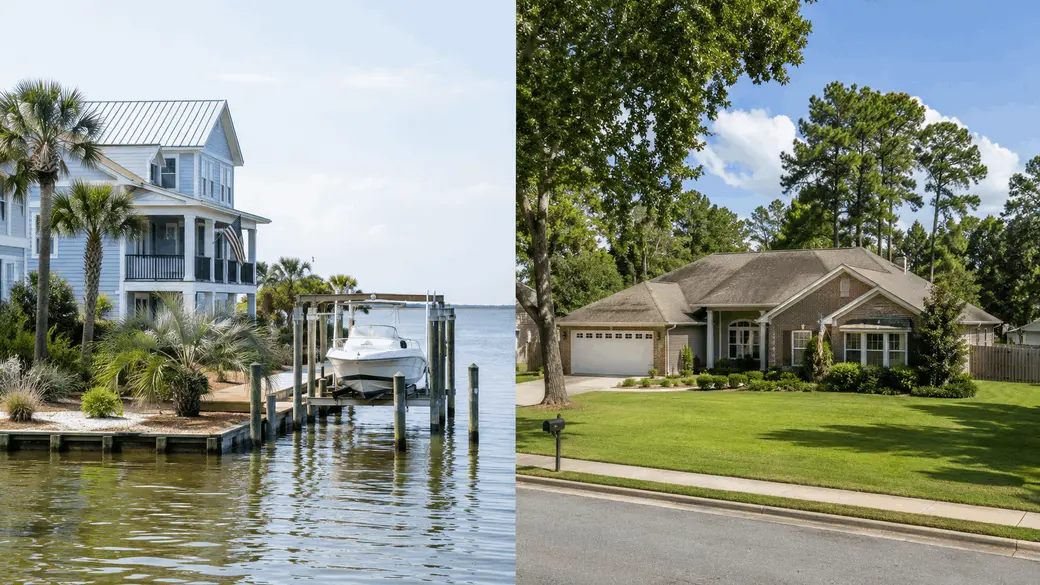
Buying a Waterfront Home vs. Inland in Northwest Florida
Choosing between a waterfront home and an inland property in Northwest Florida is about more than deciding whether you want a water view.
Waterfront ownership may provide boating access, sunsets, privacy, and a distinctive lifestyle. It can also introduce additional questions involving flood exposure, insurance, docks, seawalls, water depth, permits, corrosion, and storm preparation.
An inland home may offer more space or a wider selection within the same budget. It may also reduce certain waterfront-specific costs. However, “inland” does not automatically mean flood-free, inexpensive to insure, or protected from hurricanes.
The better choice depends on how you plan to use the home, how much maintenance you want, and which risks and expenses fit your budget.
Quick Comparison
| Buying Factor | Waterfront Home | Inland Home |
|---|---|---|
| Main lifestyle benefit | Water views, boating, fishing, paddling, or beach access | More property choices, neighborhood options, yard space, or quieter residential setting |
| Purchase price | May include a premium for frontage, views, access, or a dock | May provide more house or land within the same budget |
| Flood exposure | Requires property-specific flood and elevation research | May still face flooding from rivers, creeks, drainage, runoff, or standing water |
| Insurance | Flood, wind, roof, elevation, and construction may strongly affect cost | Wind and roof issues still matter; flood coverage may still be appropriate |
| Maintenance | May include docks, lifts, pilings, seawalls, salt exposure, and shoreline work | Usually avoids marine structures but still requires normal exterior and storm maintenance |
| Due diligence | Survey, permits, water depth, access rights, shoreline condition, insurance | Drainage, septic or sewer, commute, development plans, insurance, and neighborhood restrictions |
| Best fit | Buyers who will regularly use and value the water | Buyers prioritizing space, budget flexibility, commute, or simpler ownership |
1. First Decide What “Waterfront” Means to You
Northwest Florida contains several very different types of waterfront property:
- Gulf-front
- Bayfront
- Sound-front
- Bayou-front
- Canal-front
- Riverfront
- Lakefront
- Homes with deeded access but no private frontage
- Homes with water views but no legal water access
A Gulf-front home near 30A or Panama City Beach offers a very different ownership experience from a bayfront property in Niceville, a sound-front home in Navarre or Mary Esther, or a canal property near Pensacola.
Before comparing houses, decide what you actually want to do with the water.
Questions to Ask
- Do you want to keep a boat at the property?
- What water depth does the boat require?
- Are there shallow areas at low tide?
- Are bridges located between the property and open water?
- Is the water suitable for swimming?
- Is the shoreline protected or exposed to wakes?
- Do you want fishing, kayaking, paddleboarding, or Gulf access?
- Is a view enough, or do you need legal access?
- Would deeded community access meet your needs?
A beautiful dock is not especially useful when the water is too shallow for your boat or a low bridge blocks the route to open water.
Verify water depth, navigation routes, access rights, bridge clearance, dock ownership, and recorded easements instead of relying only on listing descriptions.
2. Compare Flood and Insurance Exposure Early
Most standard homeowners policies do not cover damage caused by flooding. Flood insurance is separate, and premiums are property-specific based partly on where and how the property is built and its replacement cost.
Waterfront buyers should request flood and homeowners insurance estimates before the inspection period is close to ending.
Review:
- FEMA flood information
- Elevation certificate, when available
- Building elevation
- Flood vents
- Prior flooding known to the seller
- Prior flood claims
- Federal flood assistance
- Roof age and condition
- Wind mitigation features
- Construction type
- Hurricane deductible
- Flood and homeowners policy deductibles
- Coverage for docks, lifts, pools, and detached structures
Florida sellers must provide a statutory flood disclosure to residential buyers at or before the sales contract is executed. The current form addresses known flooding during the seller’s ownership, flood-related insurance claims, and flood assistance. That disclosure is helpful, but it should not replace the buyer’s independent flood, elevation, drainage, and insurance research.
Inland Does Not Mean No Flood Risk
An inland home may still be affected by:
- River or creek overflow
- Stormwater runoff
- Drainage problems
- Low elevation
- Retention ponds
- Standing water after heavy rain
- Flooding from nearby ditches or established water sources
Florida’s flood-disclosure statute specifically includes overflow of inland waters, rapid runoff, and sustained standing water in its definition of flooding.
Check the exact parcel. Do not make a flood decision based only on whether a home looks close to the Gulf.
Understand the Hurricane Deductible
Florida homeowners policies may include a hurricane deductible that is separate from the standard deductible. Percentage deductibles are based on the home’s insured dwelling or structure limit, not simply the amount of an individual repair. Buyers should have the insurance agent explain the deductible in dollars before closing.
3. Waterfront Structures Require Extra Due Diligence
A waterfront purchase may include valuable structures that are not part of a typical inland inspection:
- Dock
- Pier
- Boat lift
- Pilings
- Boathouse
- Seawall
- Riprap
- Bulkhead
- Retaining wall
- Boat ramp
- Shoreline stabilization
- Dredged channel
Florida’s Department of Environmental Protection regulates many activities involving wetlands, surface waters, docks, piers, dredging, boat ramps, and shoreline stabilization. The DEP Northwest District handles permitting matters across counties including Escambia, Santa Rosa, Okaloosa, Walton, and Bay. Some qualifying single-family dock projects may use an exemption or self-certification process, while others require permits or additional authorization.
Before buying, confirm:
- Whether the dock and lift were permitted
- Whether repairs or additions were permitted
- Whether the dock is entirely within the property’s rights
- Whether submerged-land authorization applies
- Whether the permit or lease transfers
- Whether the structure complies with current restrictions
- Whether the seawall or bulkhead is failing
- Whether dredging is permitted
- Whether there are shared-dock rights
- Who pays for shared maintenance
- Whether the dock can support the intended boat
DEP advises owners seeking dock permits to contact the appropriate local district office, and permitting may involve state, water-management-district, local, or federal review depending on the project.
A general home inspector may not fully evaluate a seawall, marine pilings, lift motors, water depth, or shoreline stability. A marine contractor, structural professional, surveyor, attorney, or permitting specialist may be needed for property-specific questions.
4. Compare Maintenance, Not Just the View
Waterfront homes may require the same regular maintenance as inland properties plus care for structures exposed to water, wind, humidity, wakes, and salt.
Potential waterfront expenses include:
- Dock-board replacement
- Pilings
- Boat-lift cables and motors
- Seawall or bulkhead repair
- Shoreline stabilization
- Exterior hardware and fasteners
- Outdoor electrical components
- Elevated foundations
- Storm cleanup
- Marine growth
- More frequent washing or protective coatings
- Pool and screen-enclosure maintenance
- Landscaping exposed to wind or salt
Inland ownership may eliminate docks and seawalls, but buyers should still evaluate:
- Roof age
- Drainage
- Trees near the structure
- Septic or sewer service
- Well or public water
- HVAC condition
- Storm shutters or impact protection
- Insurance availability
- HOA restrictions
- Development planned nearby
Neither category is maintenance-free. The difference is which systems you are agreeing to maintain.
5. Consider Daily Life, Not Just Vacation Life
Waterfront living may be ideal for a buyer who plans to boat, fish, paddle, watch sunsets, or spend time outside almost every day.
The value can feel very different for an owner who only uses the dock twice a year.
Waterfront May Be a Better Fit When You:
- Own or plan to own a boat
- Regularly fish, kayak, or paddleboard
- Place a high value on views and privacy
- Are comfortable maintaining marine structures
- Have room in the budget for insurance and repairs
- Understand storm preparation
- Plan to hold the property long enough to enjoy the lifestyle
Inland May Be a Better Fit When You:
- Want more house or yard within your budget
- Prioritize commute over water access
- Prefer fewer specialized structures
- Want a broader range of neighborhoods
- Need garage, storage, workshop, or land
- Would rather trailer a boat than maintain a dock
- Want to be near the coast without living directly on the water
Northwest Florida buyers may also be balancing access to Eglin AFB, Hurlburt Field, NAS Pensacola, Duke Field, Tyndall AFB, major roads, schools, medical care, shopping, and beaches.
A home can provide an amazing weekend lifestyle while creating an exhausting weekday routine. Test the routes that matter during the times you would actually travel them.
6. Compare the Entire Ownership Budget
A waterfront home may have a higher purchase price, but purchase price is only one part of the decision.
Create a property-specific estimate that includes:
| Expense | Waterfront Questions | Inland Questions |
|---|---|---|
| Homeowners insurance | Are wind, dock, pool, and detached structures covered? | What do roof age and wind features do to the quote? |
| Flood insurance | What do elevation, construction, and flood history indicate? | Is the property exposed to inland flooding or drainage problems? |
| Maintenance | What condition are the dock, lift, seawall, and shoreline in? | What condition are the roof, yard drainage, septic, and trees in? |
| Utilities | Are irrigation, pool, lift, or exterior systems adding costs? | Are the home and lot larger or farther from utilities? |
| Association fees | Are waterfront amenities, marina access, or private roads included? | What neighborhood services and restrictions apply? |
| Reserves | How much should be saved for marine and storm repairs? | How much should be saved for normal systems and major replacements? |
| Transportation | Does the location reduce or increase normal driving? | Is the lower price offset by a longer commute? |
Do not compare only the waterfront home’s mortgage payment with the inland home’s mortgage payment.
Compare the complete annual ownership cost and the amount of cash you would want available after closing.
7. Think About Resale Before You Buy
Waterfront property may offer something that cannot be reproduced: a particular view, frontage, access route, or sunset orientation.
However, not every water-facing property carries the same future appeal.
Factors that may influence buyer interest include:
- Usable versus obstructed water access
- Water depth
- Condition of dock and seawall
- Insurance affordability
- Flood history
- Elevation
- View protection
- Bridge clearance
- Water quality
- Navigability
- Privacy
- Noise and boat traffic
- Short-term rental restrictions
- Future shoreline or nearby development
An inland property may appeal to a broader group of buyers when it offers a practical commute, more space, newer construction, manageable insurance, and easier maintenance.
The best resale decision is usually not “waterfront always wins” or “inland is always safer.”
It is buying a property whose strengths will still make sense to another buyer later.
Waterfront vs. Inland: Best-Fit Summary
| Buyer Priority | Likely Better Starting Point |
|---|---|
| Private boating access | Waterfront |
| Water views and outdoor lifestyle | Waterfront |
| More house or land for the budget | Inland |
| Fewer specialized structures | Inland |
| Fishing or paddling from home | Waterfront |
| Wider neighborhood selection | Inland |
| Shorter commute to an inland job or military gate | Depends on exact property |
| Lower flood exposure | Depends on parcel, elevation, and drainage |
| Simpler insurance | Depends on roof, construction, location, and carrier |
| Strongest long-term fit | Whichever supports the buyer’s real daily life |
Due-Diligence Checklist for a Waterfront Home
Before the inspection period ends, consider confirming:
- Flood zone and property-specific flood information
- Elevation certificate, when available
- Homeowners and flood insurance quotes
- Hurricane deductible in dollars
- Survey and legal waterfront boundaries
- Dock, lift, seawall, and shoreline permits
- Submerged-land or shared-access rights
- Water depth at different tide conditions
- Bridge clearances and navigation route
- Dock and seawall condition
- Prior flooding and insurance claims disclosed by the seller
- Expected annual maintenance and repair reserves
Due-Diligence Checklist for an Inland Home
Consider confirming:
- Drainage and standing-water history
- Flood information for the exact parcel
- Insurance quote and hurricane deductible
- Roof and major-system ages
- Septic, sewer, well, and utility details
- Trees and storm-related hazards
- Commute at normal travel times
- HOA rules and planned development
- Yard, grading, and retaining-wall condition
- Expected annual maintenance and repair reserves
FAQs About Waterfront and Inland Homes
Is an inland home automatically outside a flood zone?
No. Inland properties may still face flooding from rivers, creeks, drainage systems, runoff, low elevation, or standing water. Check the specific parcel and obtain an insurance opinion.
Does homeowners insurance cover flooding?
Generally, no. Standard homeowners and renters policies typically do not cover flood damage. Flood insurance is purchased separately.
Do I need a permit for an existing dock?
The original construction, repair, replacement, lift installation, dredging, and shoreline work may be subject to different requirements. Review available permits and contact the relevant DEP district or other permitting authority for property-specific guidance.
Is bayfront property easier to own than Gulf-front property?
It may have different exposure, access, and maintenance considerations, but it is not automatically easier. Elevation, construction, shoreline, wakes, insurance, water depth, and storm orientation vary by property.
Is waterfront property always a better investment?
No. Future performance depends on purchase price, property condition, insurance, water access, maintenance, demand, and the buyer’s holding period. A well-located inland property may be a better financial and lifestyle fit.
Should I get insurance quotes before making an offer?
At minimum, buyers should begin the insurance conversation early and make sure the contract provides enough time to evaluate coverage. A property-specific quote is especially important for older, waterfront, elevated, Gulf-front, or rental-use homes.
Final Thoughts
A waterfront home may give you a lifestyle that an inland property cannot reproduce.
An inland home may provide more space, flexibility, and a simpler set of ownership responsibilities.
The right answer comes from comparing:
- How often you will use the water
- Flood and insurance exposure
- Dock, seawall, and permit issues
- Maintenance and repair reserves
- Commute and daily routine
- Complete annual ownership costs
- Future buyer appeal
If you are comparing waterfront and inland properties in Northwest Florida, Emerald Group, Brokered by LPT Realty can help you evaluate location, water access, property condition, insurance questions, permitting concerns, commute, and long-term fit.
You can browse current homes for sale or contact Emerald Group for local guidance before making an offer.
Categories
- All Blogs (242)
- 30A Communities & Condos (12)
- Communities and Condos on the Emerald Coast (49)
- Destin Communities & Condos (8)
- Fort Walton Beach Communities & Condos (17)
- Home Buying Tips (25)
- Home Selling TIps (12)
- Investment & Rental Strategy (18)
- Local Real Estate Answers (68)
- Military Relocation & VA Buyers (21)
- Navarre Communities & Condos (14)
- Niceville Communities & Condos (6)
- Panama City Beach Communities & Condos (1)
- Pensacola Communities & Condos (3)
- Waterfront & Coastal Homes (8)
Recent Posts


"My job is to find and attract mastery-based agents to the office, protect the culture, and make sure everyone is happy! "