
Selling An Inherited Home That Needs Repairs
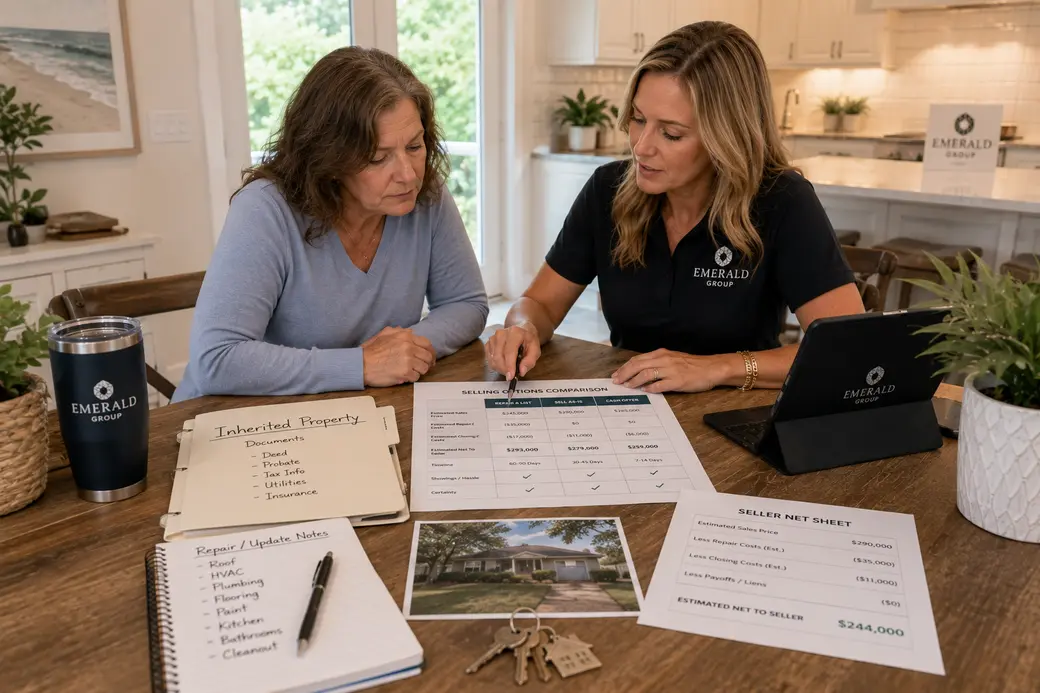
Selling an inherited home that needs repairs can feel overwhelming because you are not just dealing with a house.
You may be dealing with probate, family decisions, cleanout, deferred maintenance, old systems, insurance questions, taxes, title issues, and maybe a few mystery items in the garage that nobody wants to claim. Every inherited home comes with paperwork. Some also come with 47 coffee mugs and a lawn mower from 1989.
The good news is that you usually have options. You may be able to sell the home as-is, make a few key repairs, compare cash offers, or list it publicly so buyers can compete.
The best first step is not to start renovating. The best first step is to understand who has authority to sell, what the home may be worth as-is, what repairs actually matter, and what the likely net proceeds could look like.
The Florida Bar explains that probate is a court-supervised process for identifying and gathering a deceased person’s assets, paying debts, and distributing assets to beneficiaries. It also notes that a personal representative may need to sell real estate before settling an estate.
Quick Answer: Should You Repair Or Sell As-Is?
If the inherited home needs repairs, you should usually compare three paths before deciding:
| Option | Best Fit For | Main Benefit | Main Tradeoff |
|---|---|---|---|
| Sell as-is | Heirs who want a simpler sale without managing repairs | Faster prep and less upfront work | May sell for less than a repaired home |
| Make key repairs | Homes with fixable issues that hurt buyer confidence | May attract more buyers and stronger offers | Requires money, time, and coordination |
| Compare cash offers | Homes with major repairs, title delays, cleanout needs, or urgent timelines | Speed and convenience | Often lower net than full market exposure |
The right answer depends on the home, the heirs, the timeline, and the numbers.
1. Confirm Who Has Authority To Sell
Before spending money or signing a listing agreement, confirm who has legal authority to sell the inherited property.
That may depend on whether the home is in probate, held in a trust, owned jointly, protected as homestead, or already transferred to heirs. The Florida Bar notes that probate can involve a personal representative and that certain exceptions may apply for homestead property and some personal property.
This is where sellers should talk with a Florida probate attorney if there is any uncertainty.
A real estate team can help with pricing, prep, marketing, buyer strategy, and selling options. But questions about title authority, probate, heirs, homestead, creditor claims, or estate administration belong with an attorney.
Getting this right early can prevent delays later.
2. Secure And Stabilize The Property
Inherited homes that need repairs often sit vacant for a while. That can create extra risk.
Before listing or showing the home, check basic property needs:
- Change or confirm locks
- Check utilities
- Stop active leaks
- Secure windows and doors
- Remove obvious safety hazards
- Confirm insurance coverage
- Check for pest issues
- Keep the lawn maintained
- Gather keys, garage remotes, gate codes, and documents
- Remove valuables and personal documents
This step is not about making the home perfect. It is about keeping the property safe, presentable, and easier to evaluate.
Vacant homes can get weird fast. A small leak today can become a ceiling stain with an attitude next month.
3. Get A Realistic As-Is Value First
Before deciding whether to repair, get a realistic estimate of what the home may sell for as-is.
That means looking at the home’s current condition, location, age, layout, roof, systems, neighborhood, buyer demand, and comparable sales. An inherited home in Fort Walton Beach may need a different strategy than one in Destin, Niceville, Crestview, Pensacola, Panama City Beach, Santa Rosa Beach, Navarre, or 30A.
The as-is value becomes your baseline.
Once you know the likely as-is value, you can compare:
- What repairs may cost
- Whether repairs may improve buyer confidence
- Whether repairs may help financing or insurance
- How long repairs may delay the sale
- What the repaired value might be
- What your likely net proceeds could be under each option
Do not start with “What should we fix?”
Start with “What is this home worth today, and what would actually improve the seller’s net?”
4. Separate Important Repairs From Cosmetic Updates
Not every repair deserves your money.
Inherited homes often have a long list of issues. Some matter a lot. Some matter a little. Some are just cosmetic goblins trying to steal your weekend.
Important items may include:
- Active roof leaks
- Electrical hazards
- Plumbing problems
- HVAC issues
- Broken windows
- Wood rot
- Safety concerns
- Water intrusion
- Structural concerns
- Insurance-related issues
- Items that may block common buyer financing
Cosmetic items may include:
- Old paint
- Worn flooring
- Dated cabinets
- Old light fixtures
- Outdated appliances
- Landscaping cleanup
- General decluttering
The goal is not to renovate the home into your dream version. The goal is to decide whether a repair will likely improve the sale enough to justify the cost, delay, and stress.
5. Understand Florida Disclosure Duties
Selling as-is does not mean sellers can ignore known issues.
Florida Realtors explains that when a seller knows of facts that materially affect the value of a home, and those facts are not readily observable or known to the buyer, the seller has a duty to disclose them. Florida Realtors also notes that this disclosure duty applies to residential properties sold as-is.
This matters for inherited homes because heirs may not know everything about the property.
If you do not know something, do not guess. If you do know about a material issue, handle it carefully and honestly.
Examples may include known roof leaks, prior flooding, unpermitted work, structural issues, major plumbing problems, electrical concerns, mold or moisture issues, fire damage, or prior insurance claims.
This is not legal advice. Sellers should talk with a qualified Florida real estate attorney if they have questions about disclosure obligations.
6. Do Not Ignore Florida Flood Disclosure
Flood disclosure is especially important in Florida and on the Emerald Coast.
Florida Statute 689.302 says a seller must complete and provide a flood disclosure to a purchaser of residential real property at or before the sales contract is executed.
For an inherited home, gather whatever flood-related information is available:
- Prior flood claims
- Federal flood assistance records, if known
- Flood insurance documents
- Elevation certificate, if available
- Prior water intrusion information
- Drainage issues
- Storm repairs
- Past disclosures or seller documents
- Insurance history, where available
This can matter in coastal, low-lying, bayfront, creek-adjacent, and older neighborhoods across the Emerald Coast.
If the heirs do not know the home’s full flood history, they should be careful not to guess. Use available records, ask the right professionals, and disclose based on actual knowledge and required forms.
7. Compare Cash Offers Carefully
Inherited homes that need repairs often attract cash buyers.
That can be helpful. A cash buyer may offer speed, convenience, no repairs, fewer showings, and an easier cleanout plan.
But cash offers should still be verified and compared.
Before accepting, ask:
- Who is the actual buyer?
- Are they buying the home or assigning the contract?
- Can they provide proof of funds?
- What title company will handle closing?
- How much earnest money are they putting down?
- Who holds the earnest money?
- Can the price change after inspection?
- Are there fees the estate or heirs must pay?
- What is the estimated net at closing?
- What happens if the buyer does not close?
Florida’s Attorney General has warned consumers to watch for real estate scams, including escrow wire fraud and other deceptive practices.
Fast can be useful. Fast without verification can get messy.
8. Consider Listing As-Is On The Open Market
Selling as-is does not always mean selling privately to an investor.
Some inherited homes can be listed as-is and still attract buyers. That can include investors, renovation buyers, first-time buyers, military buyers, or buyers who want a home they can improve over time.
Listing as-is may make sense when:
- The home is safe enough to show
- Repairs are manageable
- The location is strong
- The seller wants market exposure
- Heirs can handle a normal listing process
- The home may qualify for financing
- Multiple buyers may be interested
- The seller wants to compare offers publicly
A public as-is listing can help heirs understand what the market is willing to pay instead of relying on one private cash offer.
One investor’s number is not always the market.
9. Think About Taxes Before You Spend Money
Inherited property can have tax considerations, so sellers should talk with a CPA or tax professional before making major decisions.
The IRS explains that for a home inherited from a decedent, the basis is generally the fair market value of the property on the date of death, or the alternate valuation date chosen by the personal representative of the estate.
That basis can matter when calculating gain or loss after the inherited home is sold. The IRS also explains that basis is used to figure gain or loss on the sale or disposition of property.
For sellers, this means it may be important to gather:
- Date-of-death valuation
- Appraisal, if available
- Estate documents
- Repair receipts
- Closing statements
- Prior improvement records, if available
- Property tax records
- CPA guidance before sale
Do not rely on internet tax advice for an inherited home. A CPA can help explain how sale price, basis, repairs, selling expenses, and estate details may affect the final tax picture.
10. Watch Out For Family Decision Delays
Inherited home sales can slow down when multiple heirs are involved.
Common issues include:
- One heir wants to sell and another wants to keep it
- Nobody wants to pay for repairs
- Everyone has a different opinion on price
- Personal belongings delay cleanout
- Family members disagree about cash offers
- The estate paperwork is not finished
- Nobody knows who is supposed to make the decision
Before going live, try to clarify:
- Who has authority to sign?
- Who approves price?
- Who reviews offers?
- Who handles cleanout?
- Who pays upfront costs?
- How will proceeds be distributed?
- Who communicates with the agent, attorney, CPA, and title company?
A clear decision process helps avoid drama when an offer comes in.
And yes, it is much easier to decide this before everyone is emotional about a deadline.
11. Use A Net Proceeds Comparison
For inherited homes that need repairs, the best decision is usually made with a net sheet, not a gut feeling.
Compare:
| Selling Path | Upfront Cost | Timeline | Likely Buyer Pool | Possible Net Impact |
|---|---|---|---|---|
| Sell as-is on market | Low | Moderate | Investors, renovation buyers, some financed buyers | Good if market exposure creates competition |
| Make key repairs | Moderate | Medium | Broader buyer pool | Good if repairs remove major objections |
| Full renovation | High | Longer | Stronger retail appeal | Risky if updates do not improve net enough |
| Cash offer | Low | Fast | One buyer or small investor pool | Good if speed and simplicity matter most |
The highest sale price is not always the best result. Net proceeds, timing, stress, certainty, and family needs all matter.
12. Get Local Guidance Before Signing Anything
Inherited homes that need repairs can be easy to undersell if heirs are overwhelmed.
A local real estate team can help compare:
- As-is value
- Repair priorities
- Cash offer options
- Listing strategy
- Buyer demand
- Estimated net proceeds
- Timeline
- Cleanout considerations
- Inspection risks
- Local property issues
On the Emerald Coast, location matters a lot. A dated inherited home near the water, near a military base, near 30A, near downtown Pensacola, or in a popular family neighborhood may have more options than heirs realize.
Before signing a low cash offer, compare the numbers.
Common Mistakes To Avoid
Avoid these if you inherited a home that needs repairs:
- Starting repairs before getting a selling strategy
- Accepting the first cash offer without comparing value
- Assuming as-is means no disclosures
- Ignoring probate or title authority
- Forgetting flood disclosure
- Letting family disagreements delay the sale
- Overpricing based on fully updated homes
- Cleaning out everything without checking what documents matter
- Ignoring tax basis questions
- Not getting proof of funds from cash buyers
- Waiting too long to secure or insure the property
The home does not need to be perfect. The plan needs to be clear.
FAQs About Selling An Inherited Home That Needs Repairs
Can I sell an inherited house as-is in Florida?
Yes, inherited homes can often be sold as-is in Florida, but the seller must have authority to sell, and known material facts may still need to be disclosed. Heirs should confirm probate, title, and signing authority with a qualified attorney when needed.
Should I fix an inherited house before selling?
Maybe. Repairs may make sense if they improve buyer confidence, financing options, insurance concerns, or net proceeds. Selling as-is may be better if repairs are expensive, the heirs live out of area, or speed and simplicity matter more.
Do heirs have to disclose problems with an inherited home?
Florida Realtors explains that sellers must disclose known facts that materially affect the property’s value when those facts are not readily observable and not known to the buyer. This duty can apply even when selling as-is.
Do I need probate before selling an inherited house in Florida?
It depends on how the property was titled and the estate situation. The Florida Bar explains that probate is a court-supervised process and that a personal representative may need to sell real estate before settling an estate. Heirs should ask a Florida probate attorney before signing sale documents.
Will I pay taxes when I sell an inherited home?
Possibly. The IRS explains that inherited-home basis is generally the fair market value on the date of death, or an alternate valuation date chosen by the personal representative. Sellers should talk with a CPA about basis, gain, loss, repairs, and sale expenses.
Is a cash buyer a good option for an inherited home?
A cash buyer can be a good option if the home needs major repairs, the heirs want speed, or the property is difficult to prepare for sale. Before accepting, verify proof of funds, contract terms, title company, closing costs, and the estimated net compared with listing as-is.
Final Thoughts
Selling an inherited home that needs repairs does not have to mean guessing, panic repairs, or accepting the first cash offer that shows up.
Start with the basics: confirm who can sell, understand the home’s as-is value, gather repair and disclosure information, compare selling paths, and talk with the right professionals when probate or tax questions come up.
If you inherited a home on the Emerald Coast, Emerald Group, Brokered by LPT Realty can help you compare as-is selling, repair options, cash offers, buyer demand, and estimated net proceeds before you choose a path.
When you are ready, you can browse local listings to compare nearby homes or contact Emerald Group for local inherited-home selling guidance.
Categories
- All Blogs (238)
- 30A Communities & Condos (12)
- Communities and Condos on the Emerald Coast (49)
- Destin Communities & Condos (8)
- Fort Walton Beach Communities & Condos (17)
- Home Buying Tips (23)
- Home Selling TIps (12)
- Investment & Rental Strategy (18)
- Local Real Estate Answers (68)
- Military Relocation & VA Buyers (20)
- Navarre Communities & Condos (13)
- Niceville Communities & Condos (6)
- Panama City Beach Communities & Condos (1)
- Pensacola Communities & Condos (1)
- Waterfront & Coastal Homes (8)
Recent Posts









"My job is to find and attract mastery-based agents to the office, protect the culture, and make sure everyone is happy! "