
Buyer’s Agent vs. Going Directly to the Listing Agent in Fort Walton Beach
Buyer’s Agent vs. Going Directly to the Listing Agent in Fort Walton Beach
You find a Fort Walton Beach home online that looks perfect.
The listing agent’s name and phone number are right there.
So you may wonder:
Why not just call the listing agent directly?
You can.
But going directly to the listing side and working with a real estate professional on the buying side are not automatically the same experience.
Florida law recognizes different brokerage relationships, including transaction brokerage and single agency. Florida also generally presumes transaction brokerage unless a single-agent or no-brokerage relationship is established in writing. A licensee cannot act as a fiduciary dual agent for both buyer and seller.
So the most important question is not:
“Do I need one agent or two?”
It is:
“What relationship applies, what duties does this professional owe me, and who is helping me evaluate the purchase from my side?”
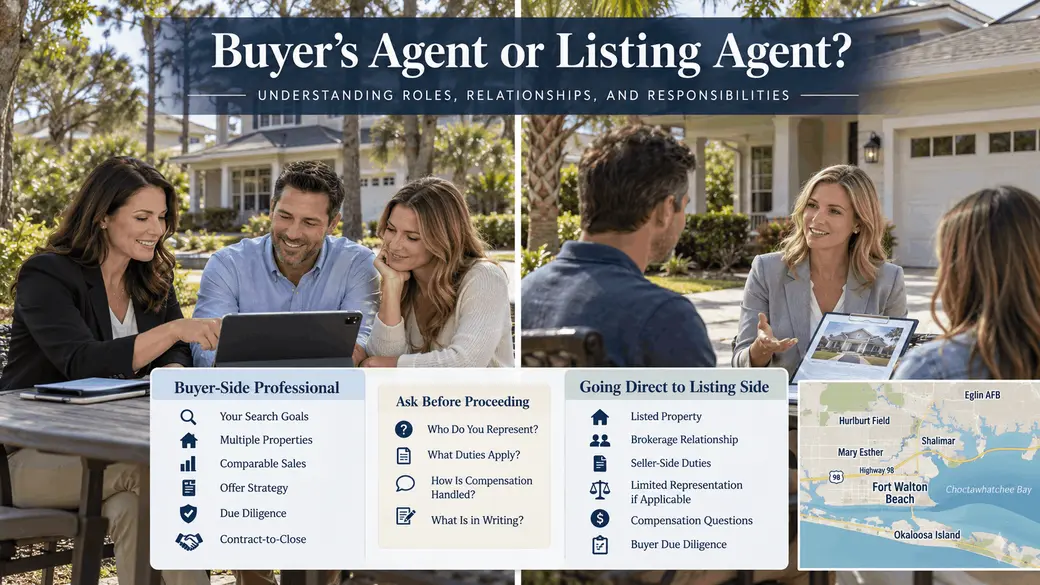
Buyer’s Agent vs. Going Direct: Quick Comparison
| Question | Buyer-Side Professional | Going Directly to the Listing Agent |
|---|---|---|
| Who starts with your buying goals? | Typically your chosen buyer-side professional | Conversation begins around the listed property |
| Can you compare other homes? | Yes | Yes, depending on the relationship and services offered |
| Who analyzes offer strategy with you? | Buyer-side professional can help from your perspective | Depends on the brokerage relationship |
| Can the professional owe fiduciary single-agent duties to you? | Potentially, if single agency is established | Not while simultaneously serving the seller as a single agent |
| Can one brokerage assist both sides? | Yes, in some circumstances through transaction brokerage | Yes, subject to Florida law and required relationship changes/disclosures |
| Does going direct guarantee savings? | No | No |
| Is compensation negotiable? | Yes | Yes |
| Written buyer agreement before touring? | Required for MLS participants working with a buyer before a tour | Not required merely to attend an open house or receive access from the listing side in that listing context |
| Best question to ask | “What services and relationship am I agreeing to?” | “Whose interests are you representing and what advice can you give me?” |
First: Understand Florida Brokerage Relationships
This is the part buyers often skip.
Transaction Broker
Florida law defines a transaction broker as providing a limited form of representation to a buyer, seller, or both without acting as a fiduciary single agent.
Statutory duties include:
-
Dealing honestly and fairly
-
Accounting for funds
-
Skill, care, and diligence
-
Disclosure of known facts materially affecting residential property value that are not readily observable
-
Timely presentation of offers and counteroffers
-
Limited confidentiality
Single Agent
A single agent has additional fiduciary duties, including:
-
Loyalty
-
Confidentiality
-
Obedience
-
Full disclosure
along with the other statutory duties.
Florida Does Not Allow Fiduciary Dual Agency
The same licensee cannot simultaneously act as a fiduciary for both buyer and seller.
Florida law does allow a single-agent relationship to transition to transaction brokerage with the required consent and disclosure.
That is why a buyer contacting the listing agent should ask:
“What brokerage relationship do you currently have with the seller, and what relationship would apply to me if I buy this home through you?”
Do not assume.
1. A Buyer-Side Professional Starts With Your Search—not One Seller’s Property
When you work with someone on the buying side, the process can begin with your goals.
That might include:
-
Purchase budget
-
Preferred monthly payment
-
Single-family vs. condo
-
Waterfront vs. inland
-
Garage
-
Yard
-
HOA preferences
-
Home condition
-
Hurlburt Field commute
-
Eglin AFB commute
-
VA financing
-
Insurance concerns
-
Timing
Then each listing gets compared with those criteria.
Going directly to a listing agent naturally starts with the home that person is marketing.
That does not prevent you from seeing other homes.
But there is a practical difference between:
“Help me find the right property.”
and
“Tell me more about this property you have listed.”
For many buyers, especially first-time or relocating buyers, that difference matters.
2. The Listing Professional Entered the Transaction Through the Seller
The listing brokerage has an existing relationship with the seller.
The exact duties depend on whether that relationship is single agency, transaction brokerage, or another legally permitted arrangement.
If the listing professional is serving the seller as a single agent, fiduciary duties such as loyalty, confidentiality, obedience, and full disclosure are owed to the seller. That professional cannot simultaneously act as your fiduciary single agent.
If the relationship involves transaction brokerage, the professional can provide limited representation under Florida law.
The takeaway is simple:
The person opening the door for you is not automatically your dedicated advocate.
Ask what relationship applies before asking for strategic advice.
3. Going Direct Does Not Automatically Save You Money
This is probably the most common misconception.
A buyer may think:
“If there is no buyer’s agent involved, the seller saves money, so I should get a discount.”
That does not automatically happen.
Current MLS policy says broker compensation is not set by law and is fully negotiable. Written buyer agreements for MLS participants must clearly address compensation, and MLSs cannot display offers of compensation to buyer brokers.
Contacting the listing agent directly does not automatically create:
-
A lower asking price
-
A lower accepted price
-
A buyer rebate
-
A seller credit
-
Reduced closing costs
-
A stronger offer
Any financial change depends on the actual brokerage agreements and negotiations involved.
Can a Seller Still Help Pay Buyer-Agent Compensation?
Potentially.
NAR’s consumer guidance explains that a buyer can still request and negotiate for compensation for their real estate professional to be paid by the seller or seller’s side, even though that compensation is no longer offered through the MLS.
That means the useful question is not:
“Is a buyer’s agent free?”
or
“Will going direct save the commission?”
It is:
“What does my agreement require, what is being offered or negotiated outside the MLS, and what will I actually owe?”
4. A Buyer-Side Professional Can Help Analyze the Offer From Your Perspective
The listing price is the seller’s asking price.
It is not necessarily the price you should offer.
A buyer-side professional can help review:
-
Recent comparable sales
-
Competing active listings
-
Days on market
-
Price changes
-
Property condition
-
Roof and HVAC age
-
Renovations
-
Lot differences
-
Waterfront features
-
HOA or condo expenses
-
Possible seller concessions
-
Financing considerations
-
Current competition
Then you decide what the property is worth to you.
That can be especially useful in Fort Walton Beach because apparently similar properties may be quite different.
Example: Two Older Homes
One may already have:
-
New roof
-
Updated electrical
-
New HVAC
-
Impact or upgraded windows
while the other may need several of those items.
The square footage may look identical online.
The ownership cost may not.
Example: Two Waterfront Homes
One property may have practical boat access.
Another may offer mostly a water view.
Dock condition, seawall condition, water depth, permitting, and navigation can all matter.
Example: Two Condos
The purchase prices may be similar while the buildings have very different:
-
Association dues
-
Master insurance
-
Reserves
-
Assessments
-
Maintenance plans
-
Rental restrictions
The comparison should go deeper than list price.
5. Fort Walton Beach Has Property Issues That Deserve Independent Due Diligence
Fort Walton Beach has homes from many construction eras as well as condos and waterfront properties.
Depending on the property, buyers may need to investigate:
-
Roof
-
HVAC
-
Plumbing
-
Electrical
-
Windows
-
Previous additions
-
Permits
-
Drainage
-
Flood information
-
Homeowners insurance
-
Flood insurance
-
HOA or condo documents
-
Special assessments
-
Dock
-
Seawall
-
Survey issues
A buyer-side professional does not replace an inspector, insurer, attorney, engineer, surveyor, lender, or other specialist.
The useful role is helping identify questions, coordinate the process, and track transaction deadlines.
That can become especially important when an inspection produces several issues at once.
6. Inspection Negotiations Can Be Easier to Navigate With Buyer-Side Guidance
Imagine the inspection finds:
-
An aging roof
-
Electrical concerns
-
Plumbing repairs
-
HVAC nearing replacement
-
Moisture intrusion
Now the real questions begin.
Depending on the contract and circumstances, you may need to decide whether to:
-
Obtain a specialist
-
Request more information
-
Get repair estimates
-
Request repairs
-
Request a credit
-
Renegotiate
-
Continue as-is
-
Exercise a contractual cancellation right
A buyer-side professional can help organize those real estate decisions.
When you are working directly through the listing side, be especially clear about whether that professional can provide the type of negotiation advice you expect given the existing relationship with the seller.
7. Remote and Military Buyers May Benefit From Separate Local Guidance
Fort Walton Beach attracts buyers relocating from outside Northwest Florida, including buyers comparing access to Hurlburt Field and Eglin AFB.
Remote buying can involve:
-
Video tours
-
Neighborhood context
-
Commute comparisons
-
Inspection coordination
-
Insurance quotes
-
Local vendor communication
-
Closing deadlines
A buyer-side professional can help compare multiple properties rather than focusing only on the seller’s listing.
This can be especially useful if you cannot visit every house in person.
Video tours should never replace a professional inspection, but they can help determine which properties deserve serious consideration.
8. Contract-to-Close Coordination Is a Real Part of the Job
Once an offer is accepted, several things can happen quickly.
Depending on the transaction, buyers may need to coordinate:
-
Earnest money
-
Inspection
-
Additional specialists
-
Loan application
-
Appraisal
-
Homeowners insurance
-
Flood investigation
-
Survey
-
Title
-
HOA documents
-
Condo documents
-
Association approval
-
Repair negotiations
-
Final walkthrough
-
Closing
The value of buyer-side guidance is not simply opening doors.
It is having someone help keep the real estate pieces moving while you make the decisions.
What About Written Buyer Agreements?
For MLS participants, current NAR policy requires a written agreement with a buyer before touring a home together, whether the tour is in person or a live virtual tour.
The agreement must address compensation in an objectively ascertainable way and state that commissions and broker fees are fully negotiable.
Before signing, ask:
-
What services are included?
-
What properties or geographic area does it cover?
-
How long does it last?
-
Is it exclusive?
-
What compensation are you agreeing to?
-
How could that compensation be paid?
-
Can the seller contribute?
-
What happens if seller-side compensation is less than the amount in your agreement?
-
How can the agreement be changed?
-
How can it be terminated?
What If You Just Go to an Open House?
NAR guidance says a buyer attending an open house independently does not need to sign a written buyer agreement simply to tour the home.
Likewise, asking a professional about their services does not by itself require an agreement.
That gives buyers room to interview professionals before deciding who they want to work with.
When Going Directly to the Listing Agent May Be a Reasonable Choice
Some buyers may prefer to deal directly with the listing side.
That could include someone who is:
-
Experienced buying real estate
-
Comfortable analyzing comparable sales
-
Familiar with Fort Walton Beach
-
Confident managing inspections and due diligence
-
Working with an attorney or other advisers
-
Comfortable negotiating
-
Clear about the brokerage relationship
The important part is that it should be an informed decision.
Going direct should not be based on an assumption that one agent automatically means:
lower price + lower fees + stronger offer.
Those outcomes are not guaranteed.
When Buyer-Side Guidance May Be Especially Useful
It can be particularly helpful when you are:
Buying Your First Home
There are many unfamiliar decisions between preapproval and closing.
Relocating
You may need help comparing multiple communities and properties remotely.
Using VA Financing
Property condition, financing, appraisal, timing, and commute may intersect.
Buying a Condo
Association dues, reserves, assessments, insurance, and rules become major parts of the purchase.
Buying Waterfront
Flood, seawalls, docks, permits, and boating access can require extra investigation.
Buying an Older Home
Roof, electrical, plumbing, HVAC, and insurance can become more important than cosmetic updates.
Questions to Ask Before Going Direct
Before deciding to work through the listing side, ask:
-
What brokerage relationship do you have with the seller?
-
What relationship would apply to me?
-
What duties would you owe me?
-
What information must remain confidential for the seller?
-
Can you advise me on what price I should offer?
-
Can you advise me to negotiate against the seller?
-
How will compensation work?
-
Does going direct change the financial arrangement at all?
-
Who will help me evaluate inspection issues?
-
What should I obtain in writing before moving forward?
If the answers are unclear, get clarity before relying on strategic advice.
Questions to Ask a Buyer-Side Professional
Before hiring someone, ask:
-
What Florida brokerage relationship will apply?
-
What services are included?
-
How do you analyze comparable sales?
-
How familiar are you with Fort Walton Beach?
-
Do you regularly work with my property type?
-
How do you handle insurance and flood questions?
-
How do you approach inspection issues?
-
Who manages deadlines after contract?
-
How does your compensation work?
-
Can seller-side compensation be negotiated?
-
How long is the agreement?
-
How can it be changed or terminated?
The goal is transparency before the serious search starts.
Buyer’s Agent vs. Listing Agent: What Is the Actual Difference?
The biggest difference is not necessarily how many people are involved.
It is the relationship and role.
A buyer-side professional can help you compare the entire market, build your purchase strategy, evaluate competing homes, coordinate due diligence, and manage the transaction from your perspective.
Going directly to the listing side can be perfectly workable for a buyer who understands the relationship and is comfortable taking on more of that analysis.
Neither approach creates guaranteed savings.
Neither makes a property automatically good or bad.
The right question is:
How much independent guidance do you want while making the purchase?
FAQs
Can I buy a Fort Walton Beach home directly through the listing agent?
Yes. Florida does not require a buyer to establish a brokerage relationship with a separate buyer-side real estate professional. The applicable brokerage relationship should be clearly understood before relying on the listing professional for advice.
Does going directly to the listing agent save money?
Not automatically. Broker compensation is negotiable, but contacting the listing agent directly does not itself create a discount, rebate, seller credit, or lower purchase price.
Can the listing agent represent both buyer and seller?
Florida does not permit fiduciary dual agency. A transaction broker can provide limited representation to a buyer, seller, or both, and a single-agent relationship may transition to transaction brokerage with the required consent and disclosure.
Do I have to sign an agreement with a buyer’s agent before seeing homes?
MLS participants working with a buyer must have a written buyer agreement in place before touring a home together. A buyer attending an open house independently does not need an agreement simply to attend.
Who pays the buyer’s agent?
That depends on the buyer agreement and transaction. Compensation is negotiable. A buyer may negotiate for a seller or seller-side source to pay some or all of the compensation, but offers of buyer-broker compensation are not displayed in the MLS.
Is a transaction broker the same as a buyer’s fiduciary agent?
No. Florida law describes transaction brokerage as limited representation without fiduciary single-agent duties. A single agent owes additional duties including loyalty, obedience, confidentiality, and full disclosure.
Is a buyer’s agent useful for VA or military relocations?
It can be, particularly when a buyer needs help comparing Fort Walton Beach properties, commute patterns, remote tours, inspections, insurance, financing considerations, and transaction deadlines.
Final Thoughts
Going directly to the listing agent can look simpler.
Working with a buyer-side professional can provide more separation between the property being sold and the advice you receive while deciding whether to buy it.
For many Fort Walton Beach buyers, that buyer-side role includes:
-
Comparing multiple properties
-
Evaluating location and commute tradeoffs
-
Reviewing comparable sales
-
Building offer strategy
-
Coordinating inspections and due diligence
-
Working through negotiation issues
-
Managing contract-to-close deadlines
Going direct may still make sense for an experienced buyer who understands the Florida brokerage relationship and is comfortable managing more of the strategy independently.
Just do not make the decision based on two assumptions that are not automatically true:
“The listing agent can represent me exactly the same way.”
and
“Going direct automatically saves me money.”
Florida law and current compensation rules make the situation more nuanced than that.
For a related guide, read 7 Reasons to Use a Buyer’s Agent in Fort Walton Beach and 5 Questions to Ask Before Choosing a Buyer’s Agent.
Emerald Group, Brokered by LPT Realty helps residential buyers compare Fort Walton Beach and surrounding Emerald Coast properties based on location, condition, financing, insurance, commute, and total ownership costs.
You can browse current listings or contact Emerald Group to discuss a Fort Walton Beach home purchase.
Categories
- All Blogs (209)
- 30A Communities & Condos (12)
- Communities and Condos on the Emerald Coast (39)
- Destin Communities & Condos (8)
- Fort Walton Beach Communities & Condos (13)
- Home Buying Tips (20)
- Home Selling TIps (11)
- Investment & Rental Strategy (15)
- Local Real Estate Answers (66)
- Military Relocation & VA Buyers (18)
- Navarre Communities & Condos (12)
- Niceville Communities & Condos (4)
- Panama City Beach Communities & Condos (1)
- Pensacola Communities & Condos (1)
- Waterfront & Coastal Homes (7)
Recent Posts



"My job is to find and attract mastery-based agents to the office, protect the culture, and make sure everyone is happy! "