
Vacation Rental vs. Long-Term Rental in Santa Rosa Beach: Which Strategy Fits?
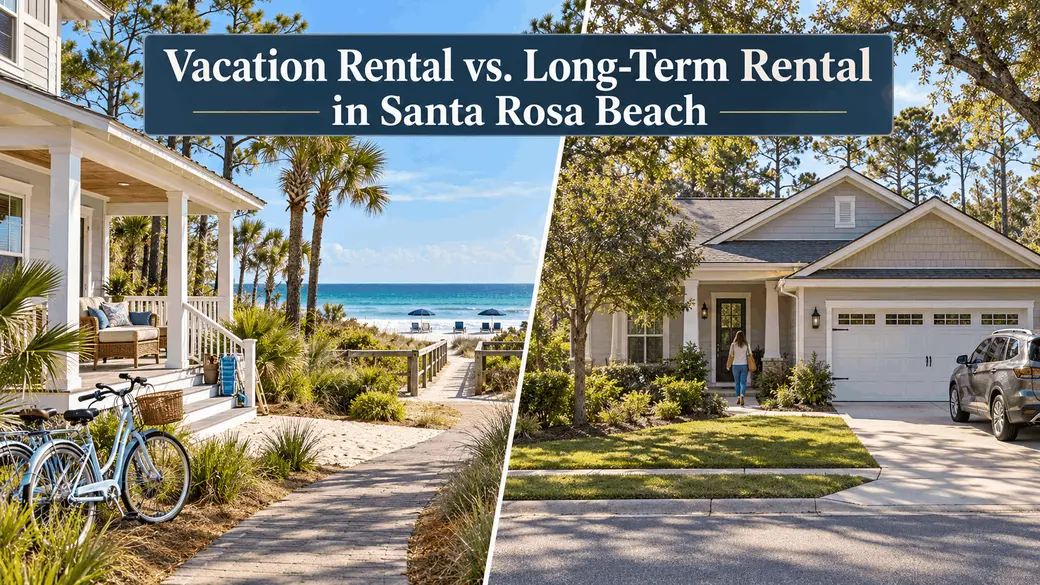
Vacation Rental vs. Long-Term Rental in Santa Rosa Beach: Which Strategy Fits?
A vacation rental in Santa Rosa Beach may fit buyers who want personal-use flexibility and are comfortable with seasonal income, furnishings, guest turnover, licensing and higher operating complexity. A long-term rental may fit buyers who prefer steadier monthly rent, fewer turnovers and a more traditional landlord-tenant relationship.
Neither strategy is automatically more profitable.
A vacation rental may produce more gross revenue during strong tourism periods.
It may also come with higher costs for:
- Management
- Cleaning
- Utilities
- Furnishings
- Guest supplies
- Repairs
- Booking operations
- Licensing
- Taxes
- Insurance
A long-term rental may produce less dramatic monthly revenue but can offer more predictable occupancy and fewer day-to-day operating demands.
The better question is:
Which rental strategy works for this specific property after you compare net income, rules, expenses and the amount of involvement you actually want?
Vacation Rental vs. Long-Term Rental at a Glance
| Investment Factor | Vacation Rental | Long-Term Rental |
|---|---|---|
| Typical Occupant | Vacation guests | Residential tenant |
| Typical Stay | Nights or weeks | Often 12 months |
| Income Pattern | More seasonal and variable | More predictable monthly rent |
| Personal Use | Easier to reserve dates for yourself | Limited during an active lease |
| Furnishings | Usually fully furnished | Often unfurnished |
| Utilities | Owner commonly pays | Often tenant-paid or divided by lease |
| Cleaning | Frequent turnover cleaning | Mainly between tenancies |
| Management Intensity | Higher | Usually lower day to day |
| Walton County STR Registration | Required for applicable STRs | Not the standard STR registration model for a traditional residential lease |
| Florida DBPR Vacation-Rental License | May be required | Traditional residential leases generally fall under a different framework |
| Tourist Development Tax | Applies to qualifying short-term accommodations | Traditional longer-term residential leasing can fall outside the tourist-tax structure |
| HOA / Condo Rules | Critical | Still important |
| Florida Landlord-Tenant Law | Different transient rules may apply depending on use | Chapter 83 residential-tenancy rules generally matter |
| Biggest Mistake | Comparing gross revenue to profit | Assuming stable rent means zero vacancy or repairs |
First: “Long-Term Rental” Does Not Simply Mean More Than 30 Days
This distinction matters in Florida.
For this article, long-term rental means the traditional residential strategy most investors picture:
one tenant + residential lease + several months or a year of occupancy.
A 45-day furnished stay is not automatically the same thing as a traditional 12-month residential lease for every licensing or tax purpose.
Walton County's Tourist Development Tax applies to qualifying accommodations rented for six months or less.
Florida's DBPR vacation-rental licensing rules use another threshold: an entire dwelling rented more than three times in a calendar year for stays shorter than 30 days or one calendar month, or regularly advertised for those short stays, generally enters the state's vacation-rental licensing framework.
So do not choose a strategy based only on labels such as:
short-term
mid-term
or
long-term.
Verify how the actual rental structure is treated under current county, state, tax, HOA and insurance rules.
1. Vacation Rentals Offer More Revenue Flexibility—but More Variability
Vacation rentals generally allow the owner to change rates based on:
- Season
- Holidays
- Local events
- Weekends
- Property demand
- Occupancy
- Booking lead time
That creates more revenue flexibility than a fixed 12-month lease.
A Santa Rosa Beach home near:
- Gulf access
- 30A
- Gulf Place
- Blue Mountain Beach
- Grayton Beach
- A community pool
- Restaurants
- Bike trails
may attract vacationers willing to pay a premium for certain dates.
But that does not mean every night gets booked.
Vacation-rental income can fluctuate with:
- Season
- Weather
- Competition
- Reviews
- Pricing
- Property condition
- Beach access
- Management
- Economic conditions
A big July number can make the spreadsheet look exciting.
February may have different ideas.
2. Long-Term Rentals Usually Give Owners More Predictable Monthly Income
A traditional residential lease works differently.
Instead of constantly repricing nights, you generally agree on a monthly rental amount for the lease period.
As of September 2026, Realtor.com reported a Santa Rosa Beach citywide median rent of approximately $2,800 per month, with 115 rental properties listed.
That number should not be used as the expected rent for an individual investment property.
Actual rent depends on:
- Bedrooms
- Bathrooms
- Property type
- Location
- Garage
- Yard
- Furnished vs. unfurnished
- Lease length
- Condition
- Proximity to 30A
- Gulf or bay access
- Amenities
The advantage is predictability.
If a qualified tenant signs a 12-month lease at an agreed rent, the owner has a much clearer idea of scheduled monthly revenue than an owner relying on nightly bookings.
3. Vacation Rentals Usually Cost More to Operate
This is where gross-income projections can get misleading.
A short-term rental may require expenses involving:
- Furnishings
- Mattresses
- TVs
- Kitchen supplies
- Linens
- Towels
- Guest supplies
- Electricity
- Water
- Internet
- Cable or streaming
- Cleaning
- Pool service
- Landscaping
- Pest control
- Booking fees
- Management
- Maintenance
- Furniture replacement
- Deep cleaning
- Marketing
- Photography
- Licensing
- Registration
- Accounting
Guests also use a property differently from one long-term tenant.
Doors open and close more often.
Air conditioning may work harder.
Luggage hits walls.
Furniture discovers what true suffering means.
That does not make vacation rentals bad investments.
It simply means:
gross vacation-rental revenue is not net operating income.
4. Long-Term Rentals Usually Have Fewer Turnover Costs
A traditional long-term rental may operate with one tenant for a full lease period.
That means fewer:
- Cleanings
- Guest messages
- Check-ins
- Check-outs
- Linens
- Consumables
- Booking-platform expenses
- Nightly pricing decisions
Depending on the lease, tenants may also be responsible for some utilities and routine obligations that a vacation-rental owner commonly pays directly.
But long-term rentals still have expenses.
Those can include:
- Vacancy
- Tenant screening
- Repairs
- HVAC
- Roof
- Appliances
- Landscaping
- Insurance
- Property taxes
- HOA dues
- Leasing costs
- Turnover between tenants
- Legal or compliance expenses
- Capital reserves
The strategy may be simpler.
It is not maintenance-free.
5. Vacation Rentals Offer Much More Personal-Use Flexibility
This is one reason Santa Rosa Beach attracts second-home buyers.
Some owners are not trying to create a pure investment.
Their goal sounds more like:
“We want our own place near 30A, but we would like to rent it when we aren't using it.”
Vacation-rental ownership can support that approach.
You can potentially block:
- Summer vacation
- Spring break
- Holidays
- Long weekends
- Family visits
and make other dates available to guests.
But Personal Use Has an Economic Cost
The weeks you want most may also be the weeks guests want most.
If you reserve:
- Fourth of July
- Spring break
- Peak summer
- Holiday weeks
for yourself, you may be removing valuable booking dates from the rental calendar.
That is completely fine.
Just model it honestly.
Personal enjoyment is value. It is not rental revenue.
6. Long-Term Rentals Give Up Personal Use in Exchange for Stability
Once a traditional tenant occupies the property under a lease, it is their home during that tenancy.
You cannot decide:
“We feel like spending next weekend at the beach.”
and move into the guest room.
That makes long-term rentals a weaker fit for buyers who want meaningful personal use.
But it can be an advantage for someone whose objective is primarily:
- Rental income
- Simpler operations
- Fewer turnovers
- Less seasonal pricing work
- Traditional residential occupancy
For that investor, personal-use flexibility may not matter at all.
7. Santa Rosa Beach Vacation Rentals Have More Regulatory Steps
Applicable Santa Rosa Beach vacation rentals operate inside a defined regulatory system.
Walton County currently requires annual short-term vacation-rental registration.
The current fee for an individual property is:
$300 per property annually.
Depending on the property and rental structure, owners may also need to address:
- Florida DBPR licensing
- Florida tax registration
- Walton County Tourist Development Tax
- Walton County STR registration
- Zoning
- Occupancy
- Parking
- Responsible-party requirements
- HOA or condo restrictions
- Insurance
Santa Rosa Beach Has a Special 2026 Renewal Detail
Walton County changed the renewal schedule for many vacation rentals beginning in 2026.
Most applicable properties are moving to an annual June 1 renewal date.
However, the county currently lists ZIP code 32459—Santa Rosa Beach—as an exception.
Those properties remain on their existing renewal cycle until further notice.
This is exactly why buyers should verify current rules instead of trusting a five-year-old blog post.
8. Vacation Rentals Have Tourist-Tax Obligations
Santa Rosa Beach sits inside Walton County's South Walton Tourist Development Tax district.
The current South Walton TDT rate is 5% for applicable short-term accommodations.
Walton County describes Tourist Development Tax as applying to qualifying lodging rented for six months or less.
That county tax is separate from applicable Florida sales taxes.
Owners also need to know who is responsible for:
- Registration
- Collection
- Filing
- Remittance
Do not assume a booking platform automatically handles every local tax obligation correctly for you.
Verify the current process with the appropriate agencies and tax professional.
9. Long-Term Leasing Has Its Own Legal Rules
A traditional long-term residential rental avoids many vacation-rental operating requirements.
That does not mean it is unregulated.
Florida's Residential Landlord and Tenant Act governs traditional residential tenancies and covers issues involving:
- Rental agreements
- Security deposits
- Advance rent
- Landlord obligations
- Tenant obligations
- Access to the property
- Lease termination
- Nonpayment
- Possession
For example, Florida has specific rules governing how security deposits and advance rent are handled.
Current Florida law also regulates notice provisions in fixed-duration leases and termination of month-to-month or other non-fixed tenancies.
This article is general real estate education, not legal advice.
Owners planning a long-term rental should use current Florida forms and get legal guidance when appropriate.
10. HOA and Condo Rules Can Decide the Strategy Before the Spreadsheet Does
This is one of the most important Santa Rosa Beach due-diligence steps.
A property may look perfect for a vacation rental.
Then you read the governing documents.
An HOA or condo association may regulate:
- Minimum rental period
- Maximum rental frequency
- Guest registration
- Parking
- Occupancy
- Pets
- Amenity use
- Golf carts
- Rental approval
Some associations may allow long-term rentals but restrict short-term stays.
Others may permit both.
Others may impose additional procedures.
So before comparing projected income, ask:
What rental use is actually permitted?
County rules do not automatically override private restrictions.
11. Location Matters Much More for Vacation Rentals
A vacation guest usually chooses Santa Rosa Beach because of the experience surrounding the property.
That can make factors such as these especially important:
- Walk to Gulf access
- Bike access
- Restaurants
- 30A
- Pool
- Gulf view
- Beach-access rights
- Parking
- Bedroom count
- Outdoor space
A property ten minutes from the Gulf may be legally rentable.
That does not mean it will compete the same way as a property where guests can walk to the beach.
Long-Term Renters May Prioritize Different Things
A long-term renter may care more about:
- Garage
- Yard
- Storage
- Highway 98 access
- Commute
- Quiet residential street
- Number of bedrooms
- Home office
- Parking
- Everyday services
That means the same property may be much better suited to one rental strategy than the other.
12. Areas Near 30A May Lean More Naturally Toward Vacation-Rental Demand
Properties close to:
- Gulf Place
- Blue Mountain Beach
- Grayton Beach
- Dune Allen
- Scenic Highway 30A
may have stronger vacation-oriented features.
But they may also come with:
- Higher purchase prices
- HOA dues
- Rental competition
- Coastal insurance exposure
- Visitor traffic
- More expensive furnishings
- Higher guest expectations
A high nightly rate does not automatically overcome a much higher acquisition cost.
13. Inland and Bay-Side Properties May Fit Long-Term Rentals Differently
Santa Rosa Beach extends well beyond 30A.
Properties around:
- Highway 98
- Point Washington
- Mack Bayou
- Hogtown Bayou
- Other inland neighborhoods
may provide:
- Larger yards
- Garages
- Traditional residential layouts
- Easier highway access
- More full-time residential surroundings
Those features may appeal strongly to long-term tenants.
Some of these homes may also qualify for vacation-rental use.
But legal eligibility and guest demand are separate questions.
A property can legally allow short stays and still make more sense as a long-term rental.
14. Vacation Rentals Can Require More Active Management
Operating a successful vacation rental can resemble running a small hospitality business.
Someone needs to handle:
- Reservations
- Guest questions
- Check-in information
- Cleaning
- Maintenance
- Pricing
- Reviews
- Emergencies
- Restocking
- Damage
- Vendor coordination
You can do that yourself or hire professional help.
Either way, the work has a cost.
Long-term rentals can involve fewer daily interactions after a tenant moves in.
But owners still need systems for:
- Rent
- Maintenance
- Repairs
- Emergencies
- Lease compliance
- Renewal
- Turnover
The question is not:
Which one requires zero work?
Neither.
The question is:
Which type of work do you want attached to the investment?
15. Financing and Insurance Need to Match the Intended Use
Do not tell the lender or insurer one thing and then operate the property another way.
A property's intended use can affect:
- Loan classification
- Down payment
- Interest rate
- Insurance type
- Liability coverage
- Underwriting
There can be important differences among:
- Primary residence
- Second home
- Investment property
- Vacation rental
Tell your lender and insurer exactly how you intend to use the property.
Get property-specific answers before closing.
16. Compare Net Income, Not Gross Revenue
This is the most important financial rule in the article.
Suppose a vacation-rental projection shows:
$100,000 gross annual revenue.
That number alone tells you very little.
Subtract realistic expenses such as:
- Management
- Cleaning
- Utilities
- Insurance
- Taxes
- HOA
- Maintenance
- Pool
- Landscaping
- Furnishings
- Replacement reserves
- Licensing
- Guest supplies
- Vacancy
- Booking expenses
Then compare the result against a realistic long-term-rental scenario.
For the long-term rental, calculate:
monthly rent × realistic occupied months
then subtract:
- Vacancy
- Insurance
- Taxes
- HOA
- Repairs
- Maintenance
- Leasing expenses
- Capital reserves
- Management if applicable
Now you are comparing strategies.
Gross revenue makes advertisements. Net numbers make decisions.
Which Strategy May Fit Which Owner?
A Vacation Rental May Fit Better If You Prioritize
- Personal use
- Nightly pricing flexibility
- Peak-season revenue opportunities
- A property close to 30A or Gulf access
- A furnished second-home experience
- Active involvement or professional vacation-rental management
- Hospitality-style ownership
A Long-Term Rental May Fit Better If You Prioritize
- More predictable monthly rent
- Fewer turnovers
- Less furnishing expense
- Less day-to-day guest management
- Traditional residential properties
- Year-round tenancy
- Simpler operating routines
Neither list identifies the more profitable strategy.
The numbers for the actual property have to do that.
Simple Example: Why Gross Revenue Can Fool You
Imagine two hypothetical strategies for the same property.
Vacation Rental
The property generates strong gross revenue.
But the owner pays:
- Utilities
- Cleaning
- Furnishings
- Management
- Pool maintenance
- Supplies
- Booking costs
Long-Term Rental
The monthly rent is lower than the vacation rental's average gross monthly revenue.
But the tenant may pay certain utilities, turnovers are less frequent and operating costs may be lower.
Which one makes more money?
You cannot answer until you subtract the expenses.
That is why we would never choose the vacation-rental strategy simply because the top-line revenue number is bigger.
Buyer Checklist Before Choosing a Rental Strategy
Before purchasing a Santa Rosa Beach property, verify:
- Exact zoning
- Allowed rental use
- HOA or condo restrictions
- Minimum rental period
- Vacation-rental registration requirements
- Florida DBPR licensing requirements
- Tourist Development Tax obligations
- Florida sales-tax obligations
- Long-term lease requirements
- Property-specific market rent
- Actual comparable vacation rentals
- Historical rental statements if available
- Beach access
- Parking
- Occupancy
- Insurance quote for intended use
- Financing classification
- Property taxes
- HOA or condo dues
- Special assessments
- Management costs
- Utilities
- Cleaning costs
- Furniture and replacement reserve
- Repair reserve
- Expected vacancy
- Personal-use dates
- Realistic net income
- Whether the numbers still work under conservative assumptions
- Whether you actually want the workload that comes with the strategy
Number 30 does not get enough attention.
FAQs
Is a vacation rental or long-term rental better in Santa Rosa Beach?
Neither is universally better. Vacation rentals may offer greater gross-income flexibility and personal use but involve more seasonality, operating expenses and regulation. Long-term rentals generally offer steadier monthly income and fewer turnovers but remove most personal-use flexibility during the lease.
How much is long-term rent in Santa Rosa Beach?
Realtor.com reported a September 2026 citywide median rent of about $2,800 per month. The appropriate rent for an individual property should be determined using comparable rentals with similar location, size, condition and property type.
Do Santa Rosa Beach vacation rentals need county registration?
Applicable short-term vacation rentals in Walton County require annual registration. The current individual registration fee is $300 per property.
Does a Santa Rosa Beach vacation rental need a Florida DBPR license?
Qualifying vacation rentals generally do. DBPR says an entire dwelling rented more than three times in a calendar year for periods shorter than 30 days or one calendar month—or regularly held out to the public for those stays—generally requires a vacation-rental license.
What is the tourist tax on Santa Rosa Beach vacation rentals?
The current South Walton Tourist Development Tax rate is 5% for applicable short-term accommodations, in addition to applicable state and local sales taxes.
Are long-term rentals subject to the same tourist tax?
Traditional residential rentals longer than the tourist-tax period are treated differently. Walton County describes its TDT as applying to qualifying lodging rented for six months or less. Owners should verify the specific lease and tax treatment rather than rely on the phrase “long-term.”
Can an HOA allow long-term rentals but prohibit vacation rentals?
Yes. Private association rules can establish minimum rental periods or otherwise restrict rental use. Review the current governing documents for the specific property.
Can I use a vacation rental personally?
Potentially, yes, subject to the ownership structure and applicable rules. Personal use is one of the major reasons buyers choose vacation-rental or second-home strategies. Remember that blocking desirable dates can reduce rental revenue.
Is a property north of Highway 98 better as a long-term rental?
Not automatically. Inland properties may have features attractive to long-term tenants, such as garages, yards and easier highway access, but the correct strategy depends on purchase price, legal rental eligibility, comparable rents, vacation demand and expenses.
Which rental strategy produces more profit?
There is no reliable citywide answer. Profit depends on purchase price, financing, occupancy, rent or nightly rates, HOA expenses, insurance, taxes, management, maintenance, utilities and other operating costs.
Final Thoughts
The difference between a vacation rental and a long-term rental in Santa Rosa Beach is much bigger than nightly rent versus monthly rent.
A vacation rental is closer to:
real estate + hospitality.
A long-term rental is closer to:
real estate + traditional residential leasing.
Vacation rentals may give you:
- Personal-use flexibility
- Seasonal pricing
- Greater gross-revenue potential
But they can also bring:
- More regulation
- Tourist taxes
- Furnishings
- Utilities
- Cleaning
- Guest management
- Seasonality
Long-term rentals may give you:
- Predictable monthly rent
- Fewer turnovers
- Simpler operations
But you give up much of the personal-use flexibility and still face:
- Vacancy
- Repairs
- Tenant-law requirements
- Leasing risk
- Capital expenses
So do not decide from the label.
Start with:
property + legal use + realistic revenue + realistic expenses + management burden + personal goals.
Then calculate the net numbers.
Emerald Group, Brokered by LPT Realty helps residential buyers compare Santa Rosa Beach properties based on rental eligibility, HOA restrictions, beach access, property type, insurance considerations and whether the property fits the buyer's intended ownership strategy.
Related Santa Rosa Beach Rental & Investment Guides
Categories
- All Blogs (223)
- 30A Communities & Condos (12)
- Communities and Condos on the Emerald Coast (45)
- Destin Communities & Condos (8)
- Fort Walton Beach Communities & Condos (15)
- Home Buying Tips (21)
- Home Selling TIps (11)
- Investment & Rental Strategy (17)
- Local Real Estate Answers (68)
- Military Relocation & VA Buyers (18)
- Navarre Communities & Condos (13)
- Niceville Communities & Condos (4)
- Panama City Beach Communities & Condos (1)
- Pensacola Communities & Condos (1)
- Waterfront & Coastal Homes (7)
Recent Posts








"My job is to find and attract mastery-based agents to the office, protect the culture, and make sure everyone is happy! "